• Skip to main content
  • Skip to primary sidebar

Active Recall!

Podcasts, videos, and iPad art

  • About
  • All Posts
  • Podcast
  • Videos
  • Book Notes

How I use my iPad Pro (January 2020) — Getting back to it

February 3, 2020

I’ve been using my iPad Pro a lot in 2020.

The iPad Pro’s signature strength has always been using the Apple Pencil. I can do a lot of things better on a MacBook. But I can’t do the things I do with the Pencil at all on the MacBook. I could get a tablet to plug into the MacBook but it wouldn’t be as direct as drawing on the screen. I could get a tablet display but the experience wouldn’t be as good as the iPad and Pencil’s.

So I set things up to be able to play toward that strength and have been using my iPad just about every day this month.

I got a cover (and stopped using the Smart Keyboard)

It’s always bugged me that the Smart Keyboard’s keys stick out the back when put into reading mode. It also doesn’t have a good way to have the raised drawing setup. So I got a cover. Just a generic one but I like the experience enough that I’ll probably shell out the dough to get Apple’s cover with the next generation.

I started using a foldable keyboard (that I’ve had for years)

I’ve been trying a setup where the iPad is in the slightly raised mode with the foldable keyboard below it. The slight raise makes it easier to draw on and keep the iPad in place. It’s easier to get over the keyboard to draw something here and there when doing things that are a little more keyboard focused.

I’ve also remembered that the on-screen keyboard is good. I wouldn’t want to write 1000 words on it but it’s great for a few sentences here and there.

I started doing some longhand writing daily on it

I’ve been starting my mornings doing some longhand writing on it.

This is one of the most enjoyable experience I’ve had with technology. I get the sense that this is the feeling people get with adult coloring books. I lose track of time easily when writing longhand in it. I’ll usually start by writing a couple pages with a sketch of where I’m at. Doodle might be more accurate.

Then I’ll open up some of the templates that I’ve made for more structured longhand writing.

Some templates I’ve been using

3×3

One I’ve been making a few iterations of this week has been the 3×3 exercise. I see this as a daily planning exercise. I’ll do a separate video about that system specifically.

The gist: I write 3 sources down the left side. I write 3 mental models across the top. (Each 1 corresponding to 1 of the sources on the left.) Then in the 9 boxes I write specific stories from the sources that match up with the theme.

Book Notes

I have a book notes template that I fill out as I read a book and am trying to make it a habit to fill out when I finish a book.

Topic Outline

I have a template for outlining a topic—here’s one I used for this video. I wrote down some quotes I could use here as well.

Weekly Plan

This is just something where I write down one AM thing and one PM thing for the upcoming week to get a sense of what blocks of time I have free. I also have a grid of 15 habits I want to cross off that week. Its…. sort of worked. Mostly as a way to see that I’m not doing a great job with habits.

Anyway, those are the templates I’ve been using and I’m planning to continue making more. Because it’s fun to do a little bit of design thinking on them. For example, I definitely want to do one that’s to track decisions each week.

Thanks for checking this out!

I’ll be doing more of these iPad journal videos, so let me know what topics you’d like to see.
  • Videos

Jocko Willink: Detach

January 28, 2020

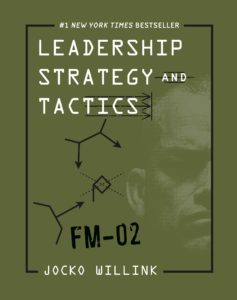
Check out the full notes for “Leadership Strategy and Tactics: Field Manual” by Jocko Willink

Tool: Plan from the bottom up and reviewed from the top

In Leadership Strategy and Tactics: Field Manual, Jocko Willink compares two of his Platoon Commanders early in his career as a SEAL. One of them wanted complete ownership over planning. The other allowed his reports to do the planning but he would review it.

The leader that wanted complete ownership over planning couldn’t detach from his own plans. He couldn’t take a higher level look at it. He would blame others when things went wrong: the plan was poorly executed or there were outside factors.

The second leader allowed his reports to plan missions. From Leadership Strategy and Tactics: Field Manual:

I was always impressed that we could spend four or five hours poring over the presumptive operation, staring at the map, discussing and poking holes in our ideas, and when we would finally present the plan to Delta Charlie, he would quickly assess it and point out a few problems. It was amazing. He seemed like a tactical genius. But what I realized later was that he was detached from the planning process, so he could see it from altitude and easily see where the holes were.

Because they did the planning, the reports felt ownership over it and were more motivated to execute it properly during mission.

Find a way to detach from your plan. Step away from your drafts. Have someone else review your outlines. If you’re leading others, remember that their feeling of ownership is important. You’ll always have that feeling, because you have other people looking to you to lead. Find opportunities for them to reinforce their own feelings of ownership.

  • Book Notes
Jocko WillinkLeadership Strategy and Tactics: Field Manual

Warming up the gear (and top 10 books of 2019)

January 22, 2020


Alright so I’m getting back to podcasting. I’m going to try taking time to write up some show notes or at least some thoughts on the episode as a supplement. Here are the different sections of the episode.

Start, stop, continue (with the podcast)

I talked about getting back to podcasting. Because there were multiple months between basically every episode last year, I feel like a broken record at this point talking about how I’m going to get back into podcasting.

But mayyyyybe this time will be different.

Anyway I did write some notes about what I want to start, stop, and continue with the podcast. I think it’s a useful exercise that’s really flexible.

It’s flexible in time. You can look at a day of work and ask yourself what went well that you should continue doing (maybe you tried working out at a different time today and felt better for whatever reason), what you should stop doing (maybe you went too long without eating in the afternoon and ended up overeating at dinner), and what you want to experiment and start doing tomorrow (pre-plan a mid-afternoon snack).

You can expand it from a day to a month to do a monthly review.

It’s flexible in that you can use it to review different aspects of things in your life. Some of the examples above were for fitness and nutrition. But you can do it to review your writing habits.

You’re pausing to reflect and build awareness around what’s working and what’s not.

3 book quotes from some of my favorite books in 2019

Okay so I think that I can just put books and the quotes here. (I’m also realizing I can just write these posts out straight into WordPress and I can save the draft page as a PDF to use as my outline while recording the podcast episode.)

Oh yeah the books and quotes.

There was no method to picking these three books to pull quotes from except that they’re from my top 10 books from 2019. (Which I’ll get into in the next section.)

Alchemy by Rory Sutherland

“This book is intended as a provocation, and is only accidentally a work of philosophy. It is about how you and other humans make decisions, and why these decisions may differ from what might be considered ‘rationality’. My word to describe the way we make decisions – to distinguish it from the artificial concepts of ‘logic’ and ‘rationality’ – is ‘psycho-logic’. It often diverges dramatically from the kind of logic you’ll have been taught in high school maths lessons or in Economics 101. Rather than being designed to be optimal, it has evolved to be useful.”

It was great to read basically example after example of how we behave irrationally. And how you can use that knowledge (without abusing it) in work you create. If you’ve ever thought “oh so that’s why…” when someone points out elevator lobbies have mirrors or reflective surfaces to give people something to do while waiting (to make the wait seem shorter) then you’ll like this book because it has a bunch of stories like that.

Linchpin by Seth Godin

“Tom Peters, corporate gadfly and writer, is an artist, even though his readers are businesspeople. He’s an artist because he takes a stand, he takes the work personally, and he doesn’t care of someone disagrees. His art is part of him, and he feels compelled to share it with you because it’s important, not because he expects you to pay him for it.”

I have a bunch of weaknesses. I want to get back into leaning into strengths this year. One of them being that I do know how to make podcasts, make videos, and make blog posts. (Not make them well, mind you, but just that I understand the logistics which might be the least important thing in reality.)
This was a weakness when combined with the idea that you should focus on one thing at a time. (Which I very much believe in, but will put on hold for a bit.) Because, well, let me put it in a couple bullets.
  • What I probably should do that I think would work: focus on either the podcast, videos, or blog (but only one of the three!) for 6 or 12 weeks and then see how that goes, then switch to one of the remaining mediums. By the end of, say, 18 weeks, I’ll have a good idea of which one I’d probably want to focus on for the longer term.
  • What I would do instead: commit to podcasting for 6 weeks, podcast for mayyyybe 2 weeks, then decide to commit to videos for 6 weeks, make 1 video, then decide I should commit to daily IG stories for 6 weeks…

Instead, I’m going to just try doing a weekly mix for a longer term. And I’ll try to centralize everything to this blog. (At least writing up notes for podcasts and videos. Spread the surface area and all that)

Anyway. The reason I mention all that is that I think that might be how I can be a linchpin, by just rotating between mediums I know how to do. If anything, I think it’ll keep me interested in making things.

And for the third quote.

Work Clean by Dan Charnas
Me and Wally are going to talk about this book in our first episode back. It’s one of the best books I’ve read, particularly if you value books that change your behavior. Here’s a list of major principles presented in the book.
Charnas spells out the 10 major principles of mise-en-place for chefs and non chefs alike: (1) planning is prime; (2) arranging spaces and perfecting movements; (3) cleaning as you go; (4) making first moves; (5) finishing actions; (6) slowing down to speed up; (7) call and callback; (8) open ears and eyes; (9) inspect and correct; (10) total utilization.
There’s surprisingly no Kindle version. I read the audiobook and recently picked up a hardcover to re-read. I really just love this book.
I think me and Wally will split the 5 principles and go over each in our next episode. Maybe make it a 2 parter or something like that.

The top-10 books I read in 2019 (here’s the full, unranked list of 52-ish books)

I have some drafts of about books from this ranking (and, of course, some navel gazing about my reading process), but here’s the list.

  1. Awareness: The Perils and Opportunities of Reality
  2. Alchemy: The Surprising Power of Ideas That Don’t Make Sense
  3. Range: Why Generalists Triumph in a Specialized World
  4. Linchpin: Are You Indispensable?
  5. Work Clean: The life-changing power of mise-en-place to organize your life, work, and mind
  6. Liar’s Poker
  7. Creative Calling
  8. Recursion
  9. Stillness is the Key
  10. The Algebra of Happiness: Notes on the Pursuit of Success, Love, and Meaning


  • Podcast
AlchemyDan CharnasLinchpinRory SutherlandSeth GodinWork Clean

Write jokes the way a photographer shoots

January 2, 2020

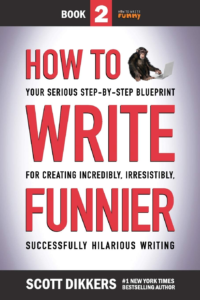
Check out the full notes for “How to Write Funnier: Book Two of Your Serious Step-by-Step Blueprint for Creating Incredibly, Irresistibly, Successfully Hilarious Writing” by Scott Dikkers

In “How to Write Funnier”, Scott Dikkers compared the practice of daily joke writing to a photographer’s process:

Photographers routinely take dozens and dozens of photos in order to find a good one. Everyone seems to understand this process when it relates to photography. The photographer’s peers understand it, and they happily offer feedback, pointing out which photo among the pile are keepers. Despite the fact that only a tiny percentage of the photos are deemed acceptable, at no point does anyone question the photographer’s skill at taking good photos.

It’s similar to the analogy with the pottery teacher or whatever kind of teacher you’ve heard for that story. But I like the scope of this photography comparison. It focuses on a single creative session for a photographer. A single shoot where shoot a whole lot more than you end up using.

(Yes, there are probably some lessons to learn from film photography and considering each shot carefully and understanding what you’re doing, but let’s stay focused on making piles of garbage because that’s a specialty of mine.)

This is a bit different than building your skill up over a school semester by making pot after pot. The photography session matches better when thinking about day tight compartments.

You’ll make some junk today, but there’s a shot or two that you can use. You can get to a good joke today if you blaze a path of bad jokes.

And it still works for the longer term, because the photographer will improve over time. Both in setting up the shots and then in building up taste in getting feedback picking the selects.

  • Book Notes
How to Write FunnyScott Dikkers

Reading Log: Pocket Full of Do

December 17, 2019

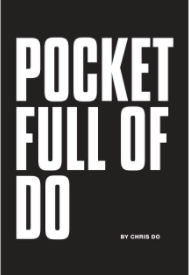
Check out the full notes for Pocket Full of Do by Chris Do

Update Feb 2021: Re-reading “Pocket Full of Do” so I made another video on one of the chapters about how you should read called “Read to Teach”.

===

https://www.instagram.com/tv/B6J-w55nr9l/

I made this IGTV video last night1.  It’s about Chris Do’s book Pocket Full of Do.

Reading it made me want to go and make something.

To go and finish something.

Instead of planning and thinking and wanting to make something and making an outline of something and buying gear and shooting video that stays on an SD card for weeks or dictating text that I never edit and on and on.

If you enjoy the content from The Futur (YouTube), you’ll enjoy this book.

Some links I mentioned in this video (that I should also write about separately):

  • Chase Jarvis: Harmony > Balance with Jason Calacanis — I mentioned this because Pocket Full of Do has a chapter where Chris Do writes about his path through the agency world and his path teaching. He was able to combine them in The Futur to create something really fulfilling by spreading his knowledge of design and marketing to more people through educational content.
  • Here’s the quote I butchered in the video: “You can’t use up creativity. The more you use, the more you have. —Maya Angelou
  • Book Notes
  • Videos
Chris DoPocket Full of Do

Reading Log: Work Clean

December 16, 2019

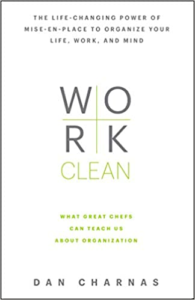
Check out the full notes for “Work Clean: The Life-changing Power of Mise-en-place to Organize Your Life, Work, and Mind” by Dan Charnas

I started listening to the audiobook version of Work Clean: The life-changing power of mise-en-place to organize your life, work, and mind by Dan Charnas. Still listening to it but wanted to practice sharing notes for books as I go along. (Vs. thinking I’ll write mega-posts about books after I finish and then not actually writing those posts or even finishing the books.)

Great book about being organized while working. I’ve never worked in a kitchen but have watched a lot of other people cooking on TV. That’s been enough for the chef stories in this book to be fascinating. It reminds me of every time Anthony Bourdain talks about the discipline of a professional kitchen being the contrast he needed from the chaos in his life in his younger days as a cook.

  • Pay attention to your movements — There are different movements that slow things down over time. If your arm is going across your body multiple times during prep, you might be able to move whatever it is you’re reaching for over to the side where your arm is. It’s a small change but they add up. Can you cut a movement out of your workflow to reduce friction? Can you automate something that takes 30 seconds that you do multiple times a day?
  • Pay attention to your workspace — For me, this has made me think a lot about how cluttered my digital workspace is. While I can get away from a messy desk by heading to a coffee shop, the digital workspace comes with me. This book makes me think I need to be more honest with the time it takes to keep things organized. And really believe it’s worth it to keep things clean a little bit at a time every day so that I don’t need to do huge audits every once in a while.
  • Pay attention to your time — This book hammers home some of the lessons from The Checklist Manifesto with specific examples of what chefs do. They design prep timing with a bunch of different dependencies between dishes. They also block the time off for prep work and cleaning as they go. This reminded me of the opening of Andy Grove’s High Output Management, which reveals the complexity involved in cooking breakfast (at scale!).

Work Clean might be going in my regular re-read rotation with books like Masters of Doom and Anything You Can Imagine. These are books that are sort of related to what I do professionally but far enough that they don’t actually make me think about work.

  • Book Notes
Dan CharnasWork Clean
  • « Go to Previous Page
  • Page 1
  • Interim pages omitted …
  • Page 64
  • Page 65
  • Page 66
  • Page 67
  • Page 68
  • Interim pages omitted …
  • Page 106
  • Go to Next Page »

Primary Sidebar

Subscribe to the channel

Focusing on making videos in 2023.

✍️ Recent Posts

Keep the page turned

An idea for what I might try to make next: How do people transform?

Carve out time away from (crappy) flow

Switching it up: CrossFit and the welders of Rogue Fitness

Musashi: the age we live in (or something)

🎧 Recent Episodes

Takeaways: “Someday is Today” by Matthew Dicks | #126

125: Creativity x Fitness – Consistency, Classics, and Crane Kicks (3 links)

118: The Psychology of Fitness: 1, 2, 3

Popular Posts

  • Book Notes – “Awareness: The Perils and Opportunities of Reality” by Anthony de Mello
  • Lightning Round Questions
  • Kobe Bryant: Every day math
  • Journal: The first 8 weeks of Active Recall
  • How to succeed as a writer (What I’ve learned by reading Bill Simmons)

By Francis Cortez

  • About
  • YouTube Channel
  • Instagram (@activerecall)
  • Twitter (@activerecall)

Categories

  • iPad Pro
  • Podcast
  • Book Notes
  • Podcast Notes
  • Weblog
  • Videos
  • Fitness
  • Creative Pages
  • iPad
Back to homepage • By Francis Cortez (@activerecall)