• Skip to main content
  • Skip to primary sidebar

Active Recall!

Podcasts, videos, and iPad art

  • About
  • All Posts
  • Podcast
  • Videos
  • Book Notes

Read, Listen, Watch: Rebel Without a Crew, Hatching Twitter, The Joy of Movement

February 26, 2020

Rebel-Without-A-Crew

A book to remind you how amazing it is today

I’m continuing reading Robert Rodriguez’s Rebel Without a Crew. It’s written as a date stamped journal and the combination of casualness and specificity makes me think it really was pretty much his journal with some very editing. It’s great in that it really captures the other work involved in making a film. There’s things like casting tiny roles and getting in touch with musicians for background music. But he goes even more into the details of the work with explaining the plan he has to make it easier to sync the separate audio and video tracks with lower end equipment that doesn’t do it automatically.

Adam Carolla was on Bill Simmons’s podcast recently (today, actually, as I write this) and they talked about Carolla’s rich man, poor man bit. The first example being, “Building a podcast studio.”

Anyway, I’m enjoying parts of Rebel Without a Crew the way that I enjoyed reading in-depth posts about how people set up their podcast studios.

Oh yeah, and on it being amazing today—I mean just the fact that you can record video (with audio synced automatically), slap a filter and some animated text on it, and broadcast it to the world in less than a minute. It’s amazing. Especially contrasted against all the hoops Robert Rodriguez describes in this book.

A book about building one technology crucial to the amazing things described above

If only there was some place online where I could share my status with other people. Close friends. Actually, maybe I’d broadcast it to the world. I’d let them know I went for a run this morning. Actually at this point (3 days of running in a row), I’d update my profile to add that I’m a runner now. If I could tag it with a location, I’d add Central Park in there. And if I could add a photo, I might throw this in there:

Central park

Depending on how many characters I had left, I’d mention that I finished Nick Bilton’s Hatching Twitter this morning.

Instead I’ll just blog about it.

(Great book that I’ll “definitely” write a separate post about. Meaning hopefully I’ll write a separate post about it, because there really is so much in here to talk about. But I want to do more posts that are a bit more about getting my thoughts down, throwing some links together, and <navel-gazing/>)

A podcast about movement and happiness

Oh yeah I forgot I have these cards for things like this. Here’s what I listened to this morning:

  • Podcast
    The Unmistakable Creative Podcast
  • Episode Title
    Kelly McGonigal: How Physical Activity Contributes to Human Happiness
  • Episode links
    Apple Podcasts • Google Podcasts • Spotify • Episode page on Unmistakable Creative

I read her book The Joy of Movement to start the year. Actually, I updated my 2020 Reading List last night so I’m just going to go ahead and block quote myself.

… Anyway, The Joy of Movement convinced me to do more cardio this year. (As I’m writing this, I’m 2 days into running the reservoir at Central Park in the morning. Let’s call that a streak.) I even tried a spin class for the first time this year. I see why she says that group cardio classes are one of the things she finds the most joy in.

It appears I already made the bad joke about being overly proud of my running streak. Anyway.

Toward the end, she mentions her book tour. A pattern she noticed is that people have this relationship with exercise where the ultimate goal is finding out how little you can do of it. I’m all for the minimum effective dose, but that’s better for something like changing your body composition. If it’s for joy, you might want the maximum effective time without diminishing returns. (Or something.)

My example is always basketball. I always look forward to basketball. It’s not going to help me build muscle or anything. I’m not very good, either. Still, I find so much joy playing it.

It’s worth finding out what type of movement brings you joy.

(And this reminds me of David Epstein’s Range, which is about generalism and one of the strategies for a career is to sample and then specialize. For joy in movement, the sampling tactic seems like a good one to apply.)

Now I’m forgetting where I heard this, but someone said we shouldn’t invent a pill that captures the end result of exercise. We should invent a pill that makes you want to exercise in the first place. Because the joy of it can really be in the activity itself.

  • Read, Watch, Listen
Adam CarollaBill SimmonsHatching TwitterKelly McGonigalNick BiltonRebel Without a CrewRobert RodriguezThe Joy of MovementThe Unmistakable Creative

Like yesterday, but on an iPad

February 21, 2020

Yesterday I wrote about creating a digital environment on my MacBook that reminds me to finish. I want to focus on finishing things. There’s a chapter in Work Clean about finishing actions that chefs take. A dish that’s 90% done may as well be 0% done.

I can get things from 0% to 30% consistently. Then I start something else. And another thing. Just a ton of outlines. So I’m going to practice those finishing moves. One element of that is having environments that encourage finishing.

Here’s the current view on my iPad:

Which I’ll try to get into more with the following workflow in Shortcuts.

Here’s the iPad Shortcut I’m using right now. Turns on some noise, turns on some music, and gets me writing in the editor.

I use a few shortcuts just about daily.

I’ve been reading High Output Management by Andy Grove. He opens with a description of making breakfast then expands it to making many of the same breakfast and automating different parts of it. Now you have a system. Things go in. An edible meal comes out. It can be looked at as a black box.

In general, we can represent any activity that resembles a production process in a simple fashion as a black box.

Over the past couple weeks, it could look like I get stuck on the couch, tap twice, and then get unstuck.

Let’s cut a hole in the black box and peek inside.

I initially tried this as a goof in Shortcuts to see if a daily automation would run automatically. (You need to confirm. I think this is because it involves payment. Which is good.) Then I found myself actually just using the shortcut. And now, as a black box, it’s been a way to get unstuck.

It might take a few minutes, but at some point I’ll usually be aware that I’m stuck on the couch in the morning. (The couch’s magnetism is so high first thing in the morning.) With the shortcut, I can get unstuck in about as many taps as it takes to find the next interesting video. (Similar to One-click ordering make it as easy to buy something as it is to leave the product page.)

Anyway, I’ve been looking for more places where I can use Shortcuts. Right now I have three that have been really useful.

Get unstuck — Actually just ordering coffee.

Generate ideas — Opens a series of prompts to create an outline

Start finishing — Music, a timer, and a nudge to write directly in the editor.

Those things together have, at the very least, helped me get off the couch and finish this post.

  • Weblog

Writing about finishing (again) (again)

February 20, 2020

When it matters and when it doesn't

Blogging about blogging warning.

Most mornings, I write a little bit and have a couple iOS shortcuts that make it easy for me to outline topics for different things.

At this point, the following seems to be true.

Things I can do quickly

  • Outline a topic
  • Make a connection between sources (something in one book relating to another, or something in a podcast relating to another thing)
  • Read things, listen to things (not particularly fast at these, but I just do it a lot because I’m a robot and I don’t listen to music much)
  • Record audio

Things I do (very very very) slowly

  • Actually write the thing / make the video
  • Edit the audio

I was giving Work Clean another listen this week, and there’s a chapter on finishing actions that reallly struck me.

Brainstorming some examples:

  • If you’re a sculptor and you’re in a room full of pencils and paper, you’ll sketch a bunch of stuff out and plan your next sculpture. If you never actually get into a room with tools to sculpt, you won’t finish, no matter how much you plan.
  • If you’re an actor and you’re in a room with the script then you can rehearse all you want. If you never get to a movie set then you’ll never finish, no matter how much you rehearse.
  • If you’re a writer and you’re in a room full of books, you can read all you want and plan your writing and keep it in your head. If you never actually get in a room with tools to write and share your ideas, you won’t finish.

I’ve caught myself in this over and over and over, and am always reminded of some of Seth Godins wisdom: Write in the Editor. (Which I mentioned here, here, here, here, and here.)

While writing this post, I’ve found something that’s seeming to work well. (Until it doesn’t, then I’ll be on the lookout for the next perfect solution.)

marsedit-setup

This helped me focus on finishing this post. If I sit in here for 30 minutes a day then I’m confident I’ll be able to publish… something.

It constantly reminds me to focus on finishing.

—

And as I was titling, categorizing, and tagging (all finishing actions) this post, I was further reminded that I’ve come to this same situation with the same conclusion in the past:

write in the editor tag

  • Blogging About Blogging
Write in the Editor

Jason Calcanis: Read the last two chapters first (Podcast Note)

February 16, 2020

  • Podcast
    This Week in Startups
  • Episode Title
    E1028: Laura Huang, author of “Edge: Turning Adversity into Advantage” shares insights on overcoming disadvantages to create an edge, being bitter vs. getting better, structural bias in tech & more
  • Episode links
    Apple Podcasts • Google Podcasts • Spotify • YouTube • This Week in Startups

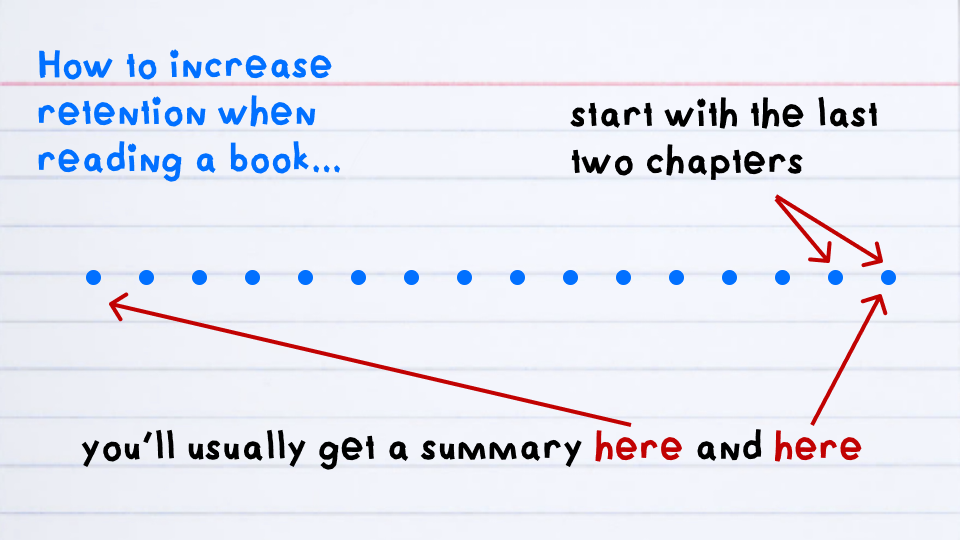
Lately I’ve been thinking about how to make the most of audiobooks and have been re-reading How to Read a Book by Mortimer J. Adler. This part of the conversation between Laura Huang and Jason Calcanis resonated with my current focus on becoming more deliberate with my reading.

Jason: I always start with the last two chapters… it’s my strategy for guests on the show. I listen… I start with the last two chapters. Because I feel like they sumize what they’ve said in the book. Then I go back and read, listen to the entire book.

Laura: Interesting.

Jason: So that I get to hear the end twice.

Laura: That’s some good BS-ing, Jason.

Jason: That’s the god’s honest truth, actually. If you actually—ever want to do it on a book, your retention will go way up.

Laura: Alright, interesting.

Jason: Because you’ve listened to the summary twice. At the beginning in the end. And good authors will a lot of time, sort of, tell you upfront: here’s what we’re going to do in the book. But there’s nothing like that summary.

The full episode is really worth listening to and reading this excerpt after typing it out gives it a court transcript sort of feel. It’s really a playful back and forth. That feeling is lost in the fidelity shift from audio to text.

In other words, I love podcasts.

  • Podcast Notes
Jason CalcanisLaura HuangThis Week in Startups

Walter and Francis, talking about returns, talking about books

February 15, 2020

Wally and finally recorded an episode together. We talk about…

  • Returns — Wally mentions the Super Bowl halftime show. I mention The Rock returning in 20111 (Here’s WWE’s 20 best returns of the 2010s
  • Goals — We do a quick review of 2019 goals and talk about some of the things we want to do in 2020. For me, the main thing is really getting consistent with the podcast, videos and blog. I want to aim for the schedule that Thomas Frank kept up with College Info Geek. I wish I could find a post where it’s referenced, but I think he mentioned on the College Info Geek podcast that the schedule was one blog post, one video, and one podcast episode each week for years. (James Clear wrote a post on Monday and Thursday every week for three years to build a massive audience.) Captain Sinbad does two videos each week (one comedy, one self-development). Most podcasts are weekly and some are daily. I’m trying to get Active Recall to have a same Bat time, same Bat place consistency.
  • Books – We talked about the books we’ve ben reading recently. Wally mentions my 2019 reading list. I need to clean it up a bit and start the 2020 reading list.

Here’s a screenshot from Ulysses of my writing from a weekend that I mentioned in the podcast. Planes really can be great for focusing. Same with hotel rooms and days without any plans.

Nearly 10,000 words in a weekend

Mid-January I flew to San Diego and wrote a lot on the plane and a lot at the hotel. I tried to have a mini think-week. A couple days instead of a full week. But then the rest of the weekend happened, I got back to New York, and just never finished. A common pattern that I want to get out of this year.

And some podcasting about podcasting notes:

  • We started recording on Zoom — The goal was to simplify the process and get rid of having multiple local recordings. The quality definitely took a hit. It’s noticeable to me but it also seemed pretty listenable.
  • I recorded with the MacBook Pro microphone — The 16” is supposed to be pretty solid. Again, I think it’s listenable but it clearly took a hit compared to the Blue Snowball. It might be worth trying Zoom but using a better mic. I’m trying to be more creative ready.

“Creative ready” is a concept from Chase Jarvis’s Creative Calling: Establish a Daily Practice, Infuse Your World with Meaning, and Succeed in Work + Life: 

Think about modifications or purchases you might make to become “creative ready” in as many environments as possible. This might mean carrying a sketch pad in your bag at all times, investing in a mobile audio rig or a digital tablet, or renting a spot at the local work-sharing space. Instead of wishing for a twenty-fifth hour in the day, ask how a relatively small investment of money might make it easier to get work done when you actually have the time to work.

I saw something recently that talked about flexibility over fidelity and that’s something I want to aim for. It’s pretty much the same philosophy as “the best camera is the one you have with you”. The best anything is the one you can have with you. I’d love to be able to just bring my laptop and be able to record an episode with Wally from anywhere with an internet connection.

Anyway, that’s another episode.

  • Podcast

Book Log: “Next” by Michael Lewis

February 15, 2020

Check out the full notes for “Next: The Future Just Happened” by Michael Lewis

I started reading “Next: The Future Just Happened” by Michael Lewis. I’m listening to the audiobook version—tonight primarily while shooting around. (I need to dig up the Brian Koppelman and JJ Redick conversation where they talk about the calm that shooting a basketball can bring. I can shoot around and listen to audiobooks and podcasts for hours without getting bored.)

Next really captures the late 90s/early 2000s and how people just really didn’t know what to think about the internet. People were discovering it was a place where you could be come an expert, anonymously. And it seemed like kids were figuring this out a lot earlier than their parents were.

  • Becoming a stock expert — The first part talks about a high school stock expert and laws that were broken (or not, depending on who you ask). He would basically invest in some stock then make a bunch of Yahoo accounts and post in finance message boards that he recommends people buy that stock. It’d go up. He’d make money.

Around that time, I remember a couple friends whose parents would day trade. They’d lose or gain thousands of dollars in a day and it just seemed like impossible amounts of money. I was definitely one of those kids addicted to the internet but never had an interest in stocks. It seemed so mysterious. (And still does, in many ways. Though reading Michael Lewis books makes me think that it’s a mystery to plenty of experts also.)

This part cracked me up, where Jonathan (the 15-year-old trader) talks about the writing style of his posts in the message boards. From Next: The Future Just Happened:

At any rate, through much trial and error, Jonathan learned that some messages had more effect on the stock market than others. “I definitely refined it,” he said of his Internet persona. “In the beginning I would write, like, very professionally. But then I started putting stuff in caps and using exclamation points and making it sound more exciting. That worked better. When it’s more exciting it draws people’s attention to it, compared to when you write, like, dull or something.”

  • Becoming a law expert (without becoming a lawyer) — The second part has a similar thread of someone really young becoming an expert without other people knowing just how young he is. Instead of playing the market, he focuses on the performance of his profile on askme.com. He answers dozens of law questions a day. I don’t remember askme.com but it sounds like someone answering a bunch of law questions on Quora today. Except without a real profile or a real name. But he does get the answers right. Which, in some cases, is all that matters. (In life, there are many cases where having the right answer doesn’t matter at all.)

Excited to continue reading the book. Also, I finished Moneyball a few days ago. I was thinking of writing some kind of mega post. Which almost guarantees you’ll never see any kind of mega post from me.

One thing from that book, though, is the idea of figuring out the right metric and optimizing for it. In baseball, when it comes to value, the As found a market inefficiency with on base percentage.

So what’s the metric for writing a blog? My hunch: consistency. So I’ll keep working on that.

  • Book Notes
Michael LewisNext
  • « Go to Previous Page
  • Page 1
  • Interim pages omitted …
  • Page 63
  • Page 64
  • Page 65
  • Page 66
  • Page 67
  • Interim pages omitted …
  • Page 106
  • Go to Next Page »

Primary Sidebar

Subscribe to the channel

Focusing on making videos in 2023.

✍️ Recent Posts

Keep the page turned

An idea for what I might try to make next: How do people transform?

Carve out time away from (crappy) flow

Switching it up: CrossFit and the welders of Rogue Fitness

Musashi: the age we live in (or something)

🎧 Recent Episodes

Takeaways: “Someday is Today” by Matthew Dicks | #126

125: Creativity x Fitness – Consistency, Classics, and Crane Kicks (3 links)

118: The Psychology of Fitness: 1, 2, 3

Popular Posts

  • Book Notes – “Awareness: The Perils and Opportunities of Reality” by Anthony de Mello
  • Lightning Round Questions
  • Kobe Bryant: Every day math
  • Journal: The first 8 weeks of Active Recall
  • How to succeed as a writer (What I’ve learned by reading Bill Simmons)

By Francis Cortez

  • About
  • YouTube Channel
  • Instagram (@activerecall)
  • Twitter (@activerecall)

Categories

  • iPad Pro
  • Podcast
  • Book Notes
  • Podcast Notes
  • Weblog
  • Videos
  • Fitness
  • Creative Pages
  • iPad
Back to homepage • By Francis Cortez (@activerecall)