• Skip to main content
  • Skip to primary sidebar

Active Recall!

Podcasts, videos, and iPad art

  • About
  • All Posts
  • Podcast
  • Videos
  • Book Notes

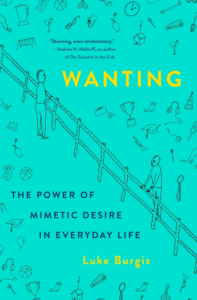
What are you wearing? (Reading Log: “Wanting” by Luke Burgis)

June 13, 2021

Check out the full notes for “Wanting” by Luke Burgis

Wrote this thread about a short exercise for anyone to start thinking about mimetic desire.

What are you wearing?

Finishing @lukeburgis's "Wanting", on mimetic theory

Came up with an exercise: For each outfit item, consider why.

Comfort, sure. But what desire did you have when you bought it? *Who* made you want it?

An athlete? Marketers? Reviewers? Friends? pic.twitter.com/1trBzLEJxJ

— Francis (@activerecall) June 13, 2021

Some additional notes, just going through each of the items in the sketch.

  • A Visualize Value hat — Bought this because I needed a hat and also just like Jack Butcher’s work and the community he’s built. And there’s some connection here to the book itself because Jack collaborated with Luke Burgis on some visualizations to celebrate the book launch. For years, he worked in advertising agencies, which roughly have a sole purpose of manufacturing desire.

Some of us like to think we recognize advertising and are above being manipulated. But you can advertise to that target as well. From Wanting:

The goal is getting people to think, “Oh, those lemming-like, silly people in the commercial.” The moment a person exempts themselves in their own mind from the very thing they see all around them is the moment when they are most vulnerable. As David Foster Wallace pointed out, “Joe Briefcase,” sitting on his couch watching the Pepsi commercial alone, thinks he has transcended the mass of plebeians that Pepsi must be advertising to—and then he goes out and buys more Pepsi, for reasons that he thinks are different.

We’re all the same: we want to be different.

  • Uniqlo oversized pocket t-shirt — Bought this because it’s comfortable. I bought like 7 of them because I don’t want to think about what I wear on most days. Yes, the whole uniform thing. It gets a little more meta, because I don’t want people to think that I do it to try to mimic Steve Jobs in some way.

I didn’t go full turtleneck. From Wanting:

Elizabeth Holmes, the former CEO of the now-defunct biotech company Theranos, openly imitated Steve Jobs. She wore black turtlenecks and hired every Apple designer she could find. But imagine if a junior employee at Theranos started mimicking Holmes, walking around in black turtlenecks, sporting blue contact lenses, mimicking Holmes’s intense stare, even speaking in Holmes’s low pitch and dry style. What do you think would happen? They’d lose their job.

  • Lululemon joggers — Again, comfort first. So I say. But there are plenty of much much cheaper pants that are comfortable. These also look good. Another thing is that a decade ago I definitely didn’t think “I need men’s pants, I should go to Lululemon.”

From a CNBC article about lululemon in 2019:

“We have very low brand awareness with men,” CEO Calvin McDonald told analysts during a meeting in New York on Wednesday. “The opportunity isn’t just to be known,” he said, “but also being understood” as a brand that men — not just women — can shop.

And from Men’s Health:

Initially, I doubted whether such unicorn pants existed. Ultimately, I discovered my new favorite pair: the ABC Pant Classic from lululemon. When the pants were recommended to me by a colleague, I was skeptical. Doesn’t lululemon make yoga pants? But it turns out they have a really sharp, functional-yet-classy menswear line and after wearing the the ABC Pant for a full week, I’m now a lululemon convert.

  • Darn Tough socks — Again, comfort. I knew my 5th and 6th pair would be comfortable because I had a few already. But what about the first pair? I probably went online and searched for comfortable socks on Amazon, looked at customer reviews, then searched Reddit for confirmation. In this case of footwear, I wasn’t following the lead of an elite athlete. I’m slowly replacing a drawer full of Nike Elite Basketball socks, which are also very comfortable, just hot for California. But I also would sometimes overthink wearing those out, because I’m not particularly good at basketball. Which shouldn’t matter, but mimetic desire is kind of all about taking things that shouldn’t matter and making them matter.
  • Nike Metcons — Working backwards: I want to be healthy so I try to work out so I want to try the thing where you treat yourself to nicer workout clothes as motivation so I bought Nike shoes but wanted shoes with a low heel to toe drop because I think it’s supposed to be better for some leg movements but mostly I learned that from blogs and podcasts I listened to when I was really into Paleo (and lightly into CrossFit for the 1-2 months before lightly injuring myself) but didn’t verify it beyond that by reading any primary sources (not that I’d understand them anyway) and I got the black and white color because it matches with most things and matching matters because I don’t want to go out in completely unmatched clothes but I also don’t want to go out too color coordinated but but but…

And if you don’t want to match, you can choose not to match—the same way as everyone else. From Wanting:

When mimetic rivals are caught in a double bind, obsessed with each other, they go to any length to differentiate themselves. Their rival is a model for what not to desire. For a hipster, the rival is popular culture—he eschews anything popular and embraces what he believes to be eclectic, but he does so according to new models. According to Girard, “the effort to leave the beaten paths forces everyone into the same ditch.”

Next thing I want: to stop overthinking.

  • Book Notes
Luke BurgisWanting

Done Well x Fulfilling

June 12, 2021

Check out the full notes for “Wanting” by Luke Burgis

From “Wanting” by Luke Burgis

The storytelling process that I use involves sharing stories about times in your life when you took an action that ended up being deeply fulfilling. Today it’s one of the first questions that I ask in any job interview because it helps cut through the thin stuff and goes straight to the essence of the person. “Tell me about a time in your life when you did something well and it brought you a sense of fulfillment,” I ask.

I just spent the last couple hours going through old posts on this site and adding books to the Book Notes section.

Activerecall co book notes
#First version of this book notes page#

I can’t say it was deeply fulfilling or done well but I feel some satisfaction. Through the past, maybe, 15 years I’ve rolled up my sleeves and written some PHP and CSS to hack on the WordPress installation of whatever site I was writing on at the time was.

Often times the things that have been deeply fulfilling have been side projects. Other times it has been work projects. I have noticed in the past few years that often times prototyping and demo’ing to teammates can be more fulfilling than digging into the details required for a public release.

These things are challenging in different ways.

It’s not an original comparison, but the past couple hours really felt like digital gardening.

And relating this to the mimetic desire topic of “Wanting”—I’ve always wanted to have a book notes page like Derek Sivers has. He continues living a lifestyle that matches up with values I want to have.

Not all mimicking is bad, so maybe this small step of making a book notes page and cleaning things up is a step in the right direction.

  • Book Notes
Derek SiversLuke BurgisWanting

Podcast outline: Storyteling

June 12, 2021

Posting this right now. I’m doing an experiment where basically anything I’m making that’s public should start from the blog.

An outline post before the podcast episode, an outline post before a video, a blog post before turning it into a Twitter thread, etc.

So this is an outline for a podcast episode, which I can happily say that I actually recorded and just need to edit. (“Just.”) 

What do humans have that other animals don’t?

In Sapiens, Yuval Noah Harari writes about the power of storytelling. Not to unlock the power of your imagination, but to get huge groups of people working together:

Telling effective stories is not easy. The difficulty lies not in telling the story, but in convincing everyone else to believe it. Much of history revolves around this question: how does one convince millions of people to believe particular stories about gods, or nations, or limited liability companies? Yet when it succeeds, it gives Sapiens immense power, because it enables millions of strangers to cooperate and work towards common goals.

That said, with the podcast, I’m sort of looking to write more for the former—I just want to entertain one person at a time.

Even if that person is me, it could still be worth it.

In Storyworthy, Matthew Dicks explains a 5-minute exercise he calls homework for life.

Take 5 minutes and write down the answer to this question: what made today different?

Five minutes a day is all I’m asking. At the end of every day, take a moment and sit down. Reflect upon your day. Find your most storyworthy moment, even if it doesn’t feel very storyworthy. Write it down. Not the whole story, but a few sentences at most. Something that will keep you moving, and will make it feel doable. That will allow you to do it the next day. If you have commitment and faith, you will find stories. So many stories.

From there, you can relate your own stories to problems the audience relates to by connecting to a shared mental model.

Create a gap

I was watching some blackhead extraction videos the other day (because I hate myself). The formula is the same: the doctor comes in with a scalpel to open a gap, removes some junk, adds some cleaner, then closes it up again.

And if you can learn to become surgical with gaps, you’ll be a better storyteller.

In Made to Stick, Chip and Dan Heath write about why some ideas stick around and others die. They write about six principles of sticky ideas. Principle 2 is unexpectedness—creating gaps in people’s heads then filling them in. 

How do you keep students engaged during the forty-eighth history class of the year? We can engage people’s curiosity over a long period of time by systematically “opening gaps” in their knowledge—and then filling those gaps.

Create an opening, remove any of their misunderstanding, fill the gap with a clear explanation. Make it stick.

  • Podcasting Log
Made to StickSapiensStorytellingStoryworthy

Atomic essay in a few minutes while lying down on the couch

June 11, 2021

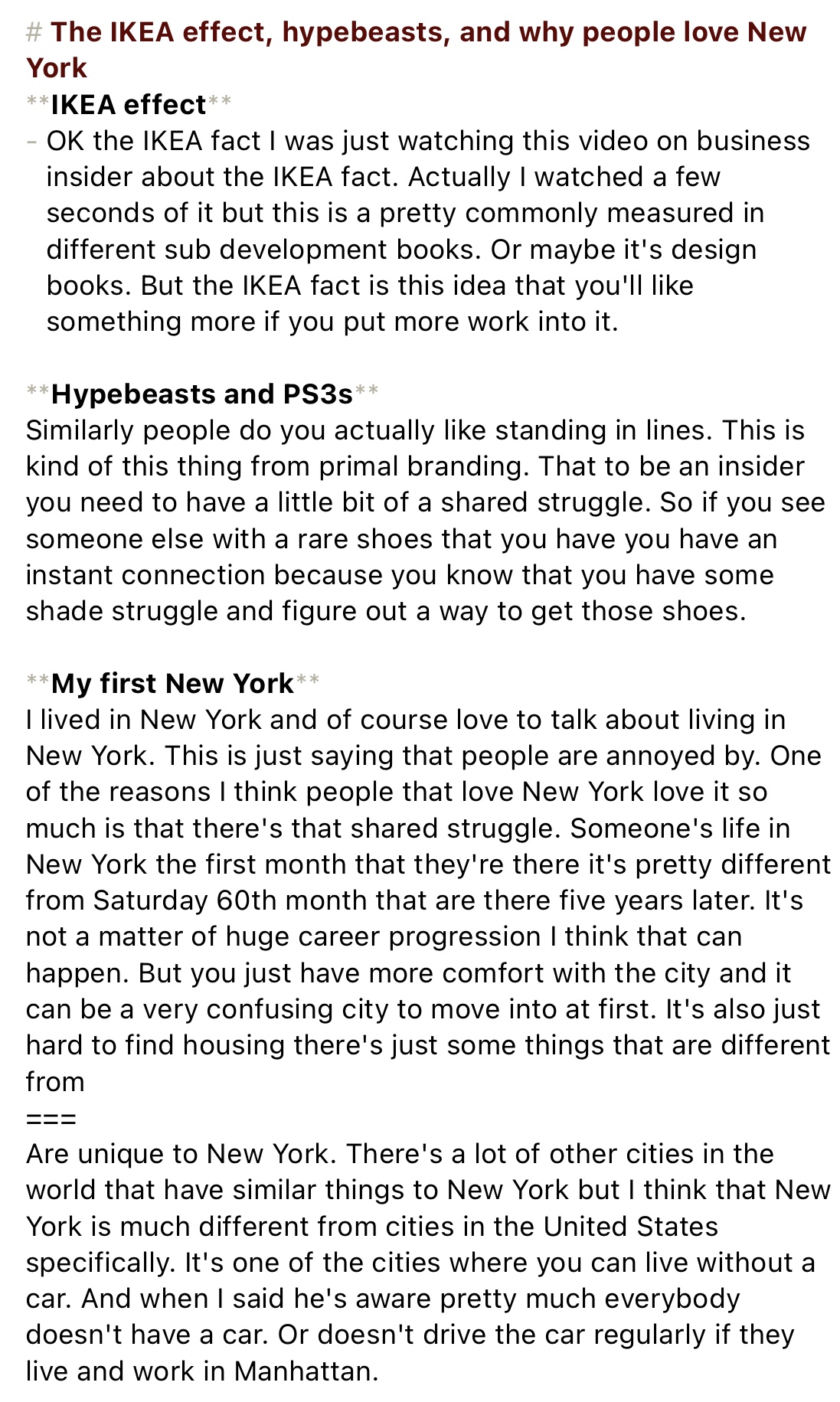
Here’s the raw output from a dictation session.

Now, I’m not arguing that it’s good, but some seeds of good ideas are there. I’ve certainly spent more time struggling, writing at a keyboard and gotten worse results.

Every time I dictate, I become convinced I should only dictate to start published writing. The speed could outweigh the negative tradeoffs.

Maybe I can…

  • Do a very quick outline
  • Smooth it out for a post
  • Record a podcast
  • Add show notes below the original post (and maybe a cleaned up transcript)

And eventually add some visuals for a thread.

Then the most popular threads can become videos.

  • Weblog

A few quick ideas for rebuilding the podcast

June 11, 2021

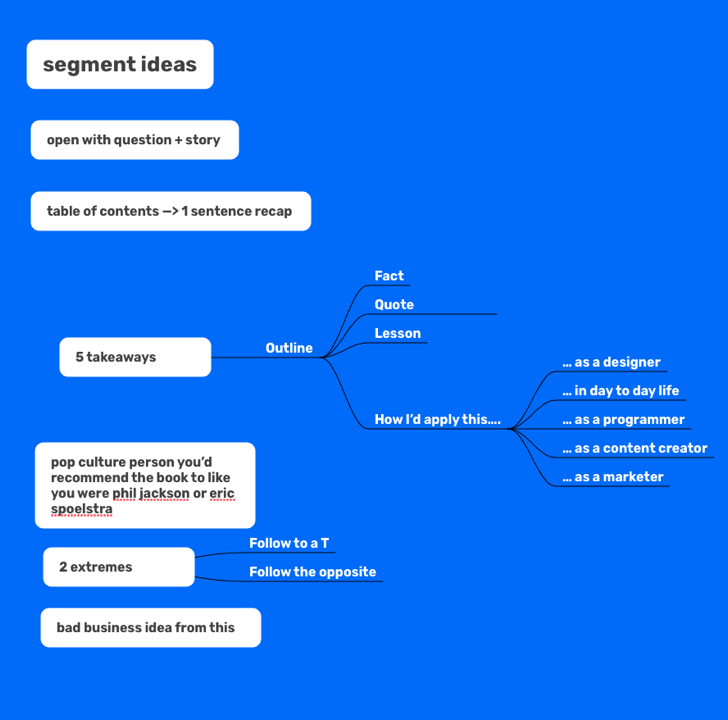
Quick brainstorm for how I can improve the podcast with some segments.

UntitledImage

I started listening to the “Make Noise” audiobook by Eric Nuzum. It’s another reminder that it’s all about storytelling.

Sometimes I’ve thought “well some of these are just nonfiction books that I’m sharing things from, no need to tell a story”.

Except that’s really the direct way to entertain. And I do believe entertainment is the first thing with a podcast before the actual information.

I loved Eminem in high school and it blew my mind that someone might like rap music but not enjoy Eminem all that much.

Me: But the lyrics man the lyrics blah blah blah.

His very good point: If the song as a whole isn’t something I want to listen to, the lyrics don’t matter.

Anyway. I need to start practicing some segments.

  • Podcasting Log

June 10, 2021 Quick Link

Liana Finck going through her illustration process

Currently reading ‘Wanting’ by Luke Burgis. Actually I’m trying the method of listening to the Audible version but adding highlights to the Kindle version. There are some fun illustrations in the book so I wanted to see who made them and came across this video showing the work.

In the personal theme of the week of looking at everything I want and figuring out where that desire comes from…

I have a bunch of gear and have been striving for the perfect desk setup to write and draw. Which means I’ve definitely spent more time watching desk setup videos than writing or drawing.

Much better to at least watch people talking about their writing or drawing process.

  • Quick Link
  • Weblog
DrawingLiana Finck
  • « Go to Previous Page
  • Page 1
  • Interim pages omitted …
  • Page 39
  • Page 40
  • Page 41
  • Page 42
  • Page 43
  • Interim pages omitted …
  • Page 106
  • Go to Next Page »

Primary Sidebar

Subscribe to the channel

Focusing on making videos in 2023.

✍️ Recent Posts

Keep the page turned

An idea for what I might try to make next: How do people transform?

Carve out time away from (crappy) flow

Switching it up: CrossFit and the welders of Rogue Fitness

Musashi: the age we live in (or something)

🎧 Recent Episodes

Takeaways: “Someday is Today” by Matthew Dicks | #126

125: Creativity x Fitness – Consistency, Classics, and Crane Kicks (3 links)

118: The Psychology of Fitness: 1, 2, 3

Popular Posts

  • Book Notes – “Awareness: The Perils and Opportunities of Reality” by Anthony de Mello
  • Lightning Round Questions
  • Kobe Bryant: Every day math
  • Journal: The first 8 weeks of Active Recall
  • How to succeed as a writer (What I’ve learned by reading Bill Simmons)

By Francis Cortez

  • About
  • YouTube Channel
  • Instagram (@activerecall)
  • Twitter (@activerecall)

Categories

  • iPad Pro
  • Podcast
  • Book Notes
  • Podcast Notes
  • Weblog
  • Videos
  • Fitness
  • Creative Pages
  • iPad
Back to homepage • By Francis Cortez (@activerecall)