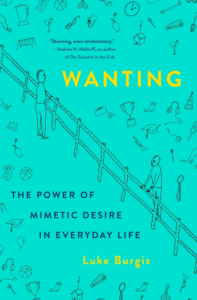
Check out the full notes for “Wanting” by Luke Burgis

Talking about “Wanting: The Power of Mimetic Desire in Everyday Life” by Luke Burgis.
- Daily Stoic: Luke Burgis on Mimetic Desire and Getting What You Want in Life
- Wikipedia: Rene Girard, Peter Thiel
He. Felt good about this in a way that there was a release and he wanted to kind of examine that. That failure and why? He felt good about something that you should feel bad about generally. Like that’s the expectation that you want to sell something and sell a company? You feel you would feel good about that, but.
It falls through. You should feel bad about that, but he felt.
He got a positive feeling from that. And the book is about. Renee. Gerard’s philosophy. Of mimetic desire. This is I I’ve never. I had heard about Rene Gerard. But it was really one of these things where like, I have no idea, really. What it was about what he was about. And I listened to a podcast episode with Ryan holiday.
Interviewing Luke Burgess about. This book wanting and they kind of described it as Ryan holiday is known for making still a philosophy. Approachable. Actually, but he always mentioned how readable the select books are, but he made it even more readable. With modern examples. And then he does make the joke that he’s become kind of like this bro.
This king of philosophy bros. He doesn’t, he doesn’t exactly say that, but he knows that. He is self-aware of some of the like negative perspective. Per perception. His books.
Then. Oh yeah. So the comparison is Luke Burgess. Similarly makes Rene Gerard. His philosophy of mimetic desire, more approachable with this book wanting.
The. Thing. The difference though, here with Renee Gerard’s writing and the stoic writings are the translations of it. Is. Gerard’s writing is very dense. I remember. Hearing about it, looking up one of his books, maybe looking at a sample. And it was one of those things where it was like, I don’t know that.
I really want to read a textbook that they, they even joke about. How a lot of times it’s as if he doesn’t want to just come out and say what he means. So it takes three readings and I didn’t do that. And actually like the, the reason that I was interested in. This book, hearing that it makes the Gerard’s philosophy.
Approachable was just seeing how influential it was because one of his students he’d be. Gerard was a professor at Stanford and one of his students was Peter teal. So Peter teal was heavily influenced by him. And then yeah, just having that understanding and How Peter teal. Looks at the future is.
He’s very. He had been very successful in kind of. Making things with this vision of the future that he has. And a lot of it is.
Influenced by.
Gerard’s. Philosophy of a medic desire. And I kind of skipped, I said I was going to talk to how I came across this. So. I kind of knew that. And then I took this course last year. It was called Rite of passage. And one of the, it was like the first online course cohort paid, not, not really the first one. I’ve taken a few different like cohort based courses online.
This one was about writing. And then the interesting thing about this one, this was the first course that I took, where you would attend lectures live. They would have breakout rooms with other students, and usually it was like a meet and greet. And you. Talk about, usually it was intros because there’s so many students, you’re always like meeting new people.
In every session. And then yeah, you, you would talk about anyway, like in one of the first one at breakout rooms that I was in. I met someone. He was talking about another student in the class. And he was saying like, oh, I’ve been reading so many books about Gerard and then this other student was writing about Gerard very deeply.
I think he released a book as well. So this goes to show just like, and I’m sitting there like. Have you guys heard? Marshmallow study. It’s just, I, I just, that was kinda when I realized, like, I’m not like I’m kind of dumb. In comparison to any of the classmates and just like generally. Then.
Yeah. That’s when I was like, oh, Gerard. Cool. And I didn’t really like have any understanding up until now. Starting to read this book. And I’m really enjoying it so far. I think I’m about. Halfway through, or maybe like a third through and just wanted to record. And first just, yeah, I just want to recommend this.
There was this phrase called quake books. I heard that first from Eric Barker, who’s the author of barking up the wrong tree. One of the first episodes me and Wally did was about barking up the wrong tree. I think we did actually three episodes. So this was 2017 or 2018, and we had the clever idea to call the third episode barking up the wrong three.
That’s why I remember that we did three episodes.
So he has one of his like bonus things for pre-ordering. The book was a list of his QuickBooks and QuickBooks are. The ones that really shifted your perspective on something like many good books will change your mind about something. That I would say is kind of the intent of a nonfiction book is to.
Change your mind about something. And yeah. Maybe like if you read. Books on the same topic, then you’re kind of just like confirming things you already believe and getting like, yeah, just validating what you believe. Like if I read another habit book, I already kind of know habits are good. Most people know habits are good. So.
It may be, it will change your mind about a specific method for it. Building habits anyway. So.
Let’s see, I kind of lost my train of thought. Oh yeah. So the QuickBooks. Yeah, just so far. I like, I listened to the intro. It was just talking about. How much desire. Just. Is all throughout our life. And it’s unavoidable. You can build awareness of your desires, but you can’t just eliminate them. That’s not the goal. That’s not what
He intends to do with this book, but it’s more about building that awareness. It reminds me similarly. I always think of. This interview with Daniel. Conaman where he’s talking about cognitive bias. And he’s been an expert in. Behavior psychology for. Decades and that yeah. The person asks like, oh, does this mean that you, you know, you don’t fall?
For these things. And he says, no, not at all. It makes him maybe more aware, but, and then he can start using the tool sets to fight those things that. Where his brain is trying to trick him. But. It doesn’t mean that it. He’s just able to avoid them completely. And in the same way, you’re not going to be able to just avoid your desires completely. I’ve been talking for like eight minutes now.
Without getting into the books. I’m going to get into the book now and just I do have some highlights here, so. Yeah. This first one, just talking about Rene Girard. The title here is a dangerous mind. The quote. Rene Girard, a French man who was a professor of literature and history of the United States had his first insight about the nature of desire in the late 1950s.
It would change his life. Three decades later when Peter teal was an undergraduate philosophy major at Stanford, the professor would alter his life too. And then. Mixed up. There’s this about what memetic means. I really didn’t understand. I would see that word and then think, oh, this must have to do with means.
And that comes later. So I have a quote about that later, but and this exer, he says, Gerard discovered that most of what we desire is mimetic or imitative. Not intrinsic humans learn through imitation to want the same things other people want just as they learn how to speak the same language and play by the same cultural rules, imitation plays a far more pervasive role in our society.
Than anyone had ever openly acknowledged. The thing that that’s the end of the quote, the. Thing here is just understand, like,
At some point, I th things like Marie Kondo and Matt de Avella. Ella with minimalism. It’s kind of looking at your material desires and getting rid of those and the minimalists. That’s like the Netflix documentary that Matt D available. Is the filmmaker for or the director for. And that’s like one step is, oh, okay. I can see that.
Yeah. Like these material desires are things that are bad for me. So I’m going to get rid of those and it’s somewhat easy because they’re physical objects. I mean, it’s not all, it’s not always easy. Because of different attachments. To those things, but, but you can physically like remove them.
And move them for your life, but then you still can kind of have those mental desires and you learn to kind of like, not want to buy things that you don’t need. But then. I remember feeling this way too with like money. And things that I’d buy that. Oh, I’ve, I’ve become enlightened. And now I want, I want experiences.
I don’t want material things. I’m going to spend my money on experiences. That’s that’s like the right way to go. And the thing is that. That’s desire as well. And you can. Get to where like you have, it can be almost as toxic as like the material desires. Where you’re just chasing these different experiences and then you desire these experiences and then you think.
That.
You. Yeah. Like you start comparing to, especially with social media. You compare it to other people and you just have this feed of other people that are, seem to be having great experiences all the time and you start to desire that, and then it can make you feel badly about like the day-to-day, because he can’t just constantly be on vacation.
So, yeah, just. This book does talk about the sources of your desires and it is from other people. And there. Is kind of, I was thinking about just like, Where most of say, like my desires came from. Of course, like parents are the first people that we start to imitate. And then I think it, it goes like parents and your direct family.
Then friends. And then eventually like, Other friends and then coworkers. Other people in the same career. And as you’re. As you get older and your social circles change. Then there’s that, but then there’s also the different types of media you consume through that and you just find different models of desire and it can be this thing that.
You learn to desire what they desire that my parents want. Me to have a stable job. Buy a house. And then one day I told them, Hey, I’m quitting this government job. And.
This was an announcement to them that I don’t have the same desires. That they have from me.
As an example. But then yeah. So my, I was, I sat down and really like, was trying to think like, oh yeah. Where did these desires come from? And It was definitely like my parents. And then I wanted to have the same desires that my brother had. And then it becomes this thing that I’m about to become a teenager and things shift. And now I want kind of.
The opposite of what my brother has, where it’s like sibling rivalry. In elementary school, I wanted to listen to the same music as him. And then in middle school, it was like, oh no, I want to like, create my own identity. And.
Yeah, and how my own identity, and this is why. My brother, we always joke about how terrible his emails were in middle. Like his email address. In middle school and. High school. And if you can imagine, like it’s any of those, everyone on aim and Zane got like screen names and. Silly names like that. I never had one that was like, I would say like, yeah, I didn’t quite have one that was.
Anything with like Asian in it or like ACN in it. And I don’t think there’s that. It’s it’s funny and funny to laugh at now, but it’s fine. Like people. Had those kinds of emails and. Yeah, and it is this thing of, I wanted to. But it is like, I want to be different, but kind of like I’ve striked it out from that. We both still want to be cool.
So you’re not really like all that different, real, like there’s only so many ways you want to. Dress a certain way and that sort of thing. And I think I should move on to another, another quote
here we go. So this topic is called celebrity Stan and fresh man is Stan. And what I have to say is like turtles all the way up is kind of what my takeaway from this is. And I’ll talk about how I got there. So celebrity, Stan is something, this is a. Term that Luper just came up with. To explain what Gerard called external mediators of desire. And he says,
Celebrity stand. I’ll, I’ll read his quote. He says Rene Girard calls, models, and celebrity, Stan. External mediators of desire. They influenced desire from outside of a person’s immediate world. From the perspective of their imitators, these models possess us. A special quality of being. And the.
Idea here is that these are just people completely like you’re not in the same league. You’re not going to have a actual rivalry with them. These are celebrities in magazines, that sort of thing. And. They can influence your desires. You want to kind of have the same desires as, as they do. And this is why.
Marketing works is that you have these celebrities that people. Can worship at at different levels of that. Yeah, I would love to be like an NBA player in certain ways. And so one way to do that is by buying their shoes, buying their apparel. And then the. Other model is what he calls freshman to Stan. And here’s the quote.
First man of Stan is the world of models who mediate desire from inside our world, which is why Gerard calls them internal mediators of desire. There are no barriers, preventing people from competing directly with one another for the same things. Between social media, globalization and toppling of old institutions. Most of us are living nearly our entire lives in fresh man of Stan.
So, this is a lot of the reason that. You might feel bad if, like I mentioned that example before, where you have social media, where you can just scroll through, see highlight reels of everyone else. And the thing is that. Yes, you probably do. Have some celebrities that you follow. On social media, but then you see people that, you know, your friends on social media, having these elevated experiences and.
Let’s say you have, yeah, you have a few hundred friends, but then like 10 of them are on vacation right now. And that can seem like, oh, well everyone’s on vacation right now because only the people that are on vacation or they’re like posting. So it can just seem like. That’s where like the, you start to calm.
Start to compete. There’s a lot of like competition in freshman to Stan. And the reason it’s called first, man, Stan, is that it is this. That feeling of entering high school or entering college where. You’re a freshmen. You want to stand out? You care about popularity because the models around you like.
Popularity is this very, very important thing. And it is. And so you want to like figure out a way to do that. Or you can also kind of like reject that. And then the thing is that you always find like you reject a, I don’t want to be like someone chasing popularity and that’s a desire to, because.
You want to. Be someone who doesn’t have that desire. So it, it is this kind of like paradox that you, you get rid of a desire and then you start to desire the lack of that desire because you think. Oh, that thing’s shallow. So I want to be, my desire is to be someone who is not shallow. And. It just, yeah. Kind of like that. That’s the reason that it’s called fresh man. Stan.
And it can be this thing that social media makes it possible to. First like, okay. So in high school, You can go through high school. Great. You become somewhat popular. You graduate, then you enter college. Now you’re comparing to these other people. And then you started all over again and then go through college.
Have different desires. Finished college. Great. Graduate go to your career and then it starts over again. You’re back to kind of being a freshmen where there’s always this competition, and then you can just. Keep it going because social media makes it possible. Like even in a career, like. You Excel.
At your company. But then you see things in the media, like 30, under 30. Wow. Okay. So, now I desire that that like wild success at an early age and. Then you can yeah, go on too. The internet and just see people winning. Over and over, and it’s the thing of people sharing. Screenshots of, of.
They’re like drop shipping sales, sharing screenshots of their portfolio. And you can just constantly compare. And then just talking about like the contrast. Where your Jack things. So you’ll also see people. That post screenshots of it just all just bleed. It was just all red, right on their stock, Charla their portfolio.
And then it becomes a thing that, oh, I want to be like that too. That I’m so comfortable with my finances that I’ll even share like my, when I’m losing. And that’s, that’s another desire. So this is just like, Desire everywhere. Different kinds of desire, and that can be. I tough thing. And I’m going to get, move into this next quote again, I think I was talking a little too much just about.
Tangents anyway. This was called. Why do all hipsters look? Oh, and the reason I said turtles all the way up is that. That’s the idea that like this. Comparison can. With the internet comparison can just never stop and you can just always look at higher and higher and higher people. You can succeed all you want until you’re comparing yourself to Jeff Bezos.
Financially and it’s like, well, okay. Maybe, maybe. And. It won’t stop. Strictly by becoming more successful. The treadmill doesn’t, that’s not how you stop the treadmill. There’s probably ways to stop the treadmill, but it’s not by. It’s definitely not by like increasing the speed on it. So why do all hipsters look alike?
This is a quote from the book.
He says, why do all hipsters look alike? And why does nobody identify themselves as one? The answer is mirrored imitation mirrors, distort reality. They flip the sides on which things appear. Your right hand appears on the left side of the mirror. And your left hand appears as if it’s on the right side of the mirror. The mirror image is in some sense, an image of opposites.
Mirrored imitation then is imitation. That does the opposite of whatever arrival does. It is reflexive to arrival. By doing something different from what the rival does and. This is that thing where.
The desire becomes being the opposite of. Arrival. And like I mentioned, sibling rivalry with my brother, like, oh, I want to dress differently than him. Oh, he’s into cars. I’m going to not be into cars or. But then. Definitely. There were other things where I definitely wanted to imitate him. And he was, he was making a website. I’m very glad I learned to make websites.
And now we both have careers doing that. So that was a case where I’m, I’m super grateful that I had that nomadic desire and that.
And here’s another quote. It is. An unbelieved truth is often more dangerous than a lie. The lie in this case is the idea that I want things entirely on my own. Uninfluenced by others that I’m the sovereign king of deciding what is Wantable and what is not. The truth is that my desires are derivative mediated by others. And that I’m part of an ecology of desire that is bigger than I can fully understand.
The thing. So that’s ended the quote. What this always reminds me of is. Hacker news. With programmers, anytime, some kind of like. Marketing topic comes up. They’re so insanely against marketing and they think they’re above it. They have their ad blockers on that sort of thing. But it’s and so they want to be like the opposite of that. And that’s.
That’s their mimetic desires to be someone that is. Logical can think for themselves and is uninfluenced by. Marketing. But at some point they’ve picked, they could take a look at their laptop, their computer, what’s inside and.
There was some form of marketing that, that influenced them that maybe they don’t care about the clothes they wear, but marketing. Is influencing them and then. At another level too, like with, and this is one of those things where I thought I’ve in the past, definitely thought like, oh, I’m above this. I, I can see through this marketing stuff. Things like.
iPods iPhones, apple devices. W AirPods were like, Right now a lot of people like. Sometimes I don’t do this quite as much anymore, but I used to like read the comments and slick deals a lot. And any time it was kind of like hate reading, I guess. Just to make myself feel outraged. I would read like the comments on like an AirPods deal. And then of course there’s people in there that are like, oh, look at all these sheep.
They bought these just to want. Or just because they want to look cool instead they look stupid. Blah, blah, blah. And it was this thing where I would, you know, scoff and think like, oh no, They don’t understand what, like how smooth the ecosystem is and how great of a listening experience it is and how seamless.
It is to like switch devices when I have AirPods and, or like with my iPod, like, oh no, they don’t know. Like, it’s not just because it looks cool. It’s because just like the experience is good on it and, and that sort of thing. And they’ll never understand. And that was me with my desire was to. And this isn’t to say there’s definitely like a lot of people I would say.
The buy AirPods because it’s trendy. And I wanted to think, oh, I’m not doing that because it’s trendy. That was my desire is like, oh, I don’t want to. So that, that it is one of these things where. I want it to be like, I guess. A hipster or like a non-conforming like I was conforming, but not for the same reasons as, as other people.
So. Yeah. The idea that. You’re uninfluenced by marketing or that like marketing is this. Evil. I think that yeah, like marketing, you just is. I think it’s a very powerful thing. And it’s that thing of like, with great power comes great responsibility. Now I feel like a Spiderman ad and I’m going to go into this next.
Excerpt. It is about what I mentioned. Memes. And memetics and ed.
Anyway. That they are different things. So. Let’s see. So this is the quote. Docking’s theory of me. I’ll start from the beginning. Richard Dawkins coined the word meme in his book, the selfish gene. He was attempting to explain. The spread across time and space of non-material things such as ideas, behaviors, and phrases. He called these things means cultural units of information that spread from person to person through a process of imitation Dawkins theory of memes and Gerard’s theory of mimetic desire, both view imitation as foundational to human behavior.
However, the two theories are different in almost every respect. According to doc NS means work in a similar way to biological genes. Their survival. Depends on they’re being passed on and replicated as perfectly as possible.
Here we go. And then. Actually I’m going to skip a little bit. I feel like I’m reading like two months. Much. So you said, okay, here we go. According to me, in theory, the spread of memes through imitation leads to the development and sustainability of culture. According to Gerard’s theory, mimetic theory.
Culture is formed primarily through the imitation of desires, not things. And desires are not discretes, static and fixed. They are open-ended dynamic and volatile. My takeaway from this is that we’ve seen just like the power of beams names, stocks. What Elon Musk can do with meme. And yeah, just that.
Memes can be very powerful. And then also on the other side, mimetic desire and having an understanding of it and like, is that like, it’s, it’s kind of like a foundational thing to marketing and marketing is this. A very powerful force in our lives.
That. These are two skills that you can build that if you can be effective, if you were able to be, I mean, NFTs have made it like put a monetary value on some beams in a way. Where someone will. That was in like the photo Like there’s a, that like meme of the girl with the burning house.
And yeah, I think she had like some NFT and, and got paid out and that is. Just the saying that. They’re very valuable. So learning to make those is a good skill. And then. The medic desire, being able to create. And master that. And influence other people. It’s like influencers and content creators, and there’s some overlap and it is a very valuable.
Set of skills. So. Class. Quote. Because this is almost half an hour. He does have this small section about mimetic desire. That’s very close to you. Me and talking about my brother and that I wanted to listen to the same music he listened to in middle school, elementary school. And his favorite artist was Tupac. I remember him.
Crying when we heard the news that Tupac died. And I think I must have been in third or fourth grade and I was like, why is my brother crying? I’m so sad about this. And now I understand, like, this is your hero. Dying. So, yeah, it just talks about the, the medic. Just the imitation though, that took place where.
West coast rapper makes one of the east coast rapper. And then I’ll just read this quote. The east coast or in 1993, Sean Combs signed the notorious B. Gee to his upstart record label, bad boy records. Biggie’s song who shot you’re released on the B-side of a single was interpreted by a young west coast rapper Tupac Shakur.
As mocking him to pocket recently been the victim of a gunpoint robbery during which he was shot. Shortly after he was signed to the controversial music label, death row records. And I’ll, I’ll summarize this part. Escalating conflict ensued. Eventually this rivalry ended with both of them.
Dying dying. Separately, like getting shot. I think within months of each other. So. And it is an interesting thing to that. Then Tupac became kind of this. The medic figure for other rappers to follow. If you were going to be like this raw, I guess like any kind of like.
Up and coming rapper wood.
He wouldn’t be the worst person to, to follow in the footsteps of, if you want to build a huge fan base.
Wow. Because it is this mimetic desire of. So there, there’s a story in this book, just talking about Steve jobs, his early years and how like, just examples, like he wouldn’t shower. He would like. Leave to. Yeah, he would kind of do his thing and he just seemed to have some immunity to the mimetic desires that other people have of, I want to have good hygiene and have this.
Nice appearance and be polite and that kind of thing. It was. So it can be this thing where it’s impressive when you see other people who don’t have those desires. And sometimes it’s, it’s not impressive. So, you know, the people that like. Oh, I don’t care. What other people think about me and anyone that says that.
Very much wants people to think that about them. That’s like a game of Thrones. Line, but
But yeah, th this is. Yeah. Back to Tupac, Tupac and Steve jobs. So Tupac is this. He would create. Yeah. And he was a memetic figure. In that. It seemed like, oh, he doesn’t care about the rules of society and wow. That looks really cool. We end up. Of course like throughout culture. We love rebels. There’s like, yeah, all sorts of different rebellious figures. And it’s always going to be a character in stories forever and ever, because we do idolize people who don’t follow society’s rules and that kind of thing. Anyway.
This is pretty long and I’ll probably do a second part. Because really enjoying this book. I think I mentioned quake books. So this is definitely like shaping up to be one of those QuickBooks for me, where at least for this week. Yeah, I’m just looking at like, oh, well, why do I desire this thing or that thing? Like, why am I even making this podcast?
Why, why do I have this? W. Yeah, why. Why did I buy all these things? And as an example, I, I bought this free, right. To close with. I bought this free right traveler. And it’s just this keyboard with a paper ink screen, and I love writing on it. And I think the reason that I bought it was, and this is the thing, like, why do you want.
It’s like the five whys. Just rephrase it a little bit. Like. What did you want? I’m going to just talk to myself. So what did I want? With buying the free right. Traveler. I think what I wanted was focused sessions of writing and I. The reason I want that is because I think that can lead to like creating content, but also it can be meditative.
So I want to have that feeling as well. And then you can just keep going with the different ones similar to like the five why’s that it can go all the way up to two. Oh, okay. I want. This and that and that, and it leads up to like, oh, I want to be happy and have like a.
Financial freedom. And that will come through like a foundation of writing and that that’s our thing. Anyway. Thanks for listening. And check out the book, wanting by Luke Burgess.