• Skip to main content
  • Skip to primary sidebar

Active Recall!

Podcasts, videos, and iPad art

  • About
  • All Posts
  • Podcast
  • Videos
  • Book Notes

Book Notes: “Indistractable” by Nir Eyal

September 9, 2019

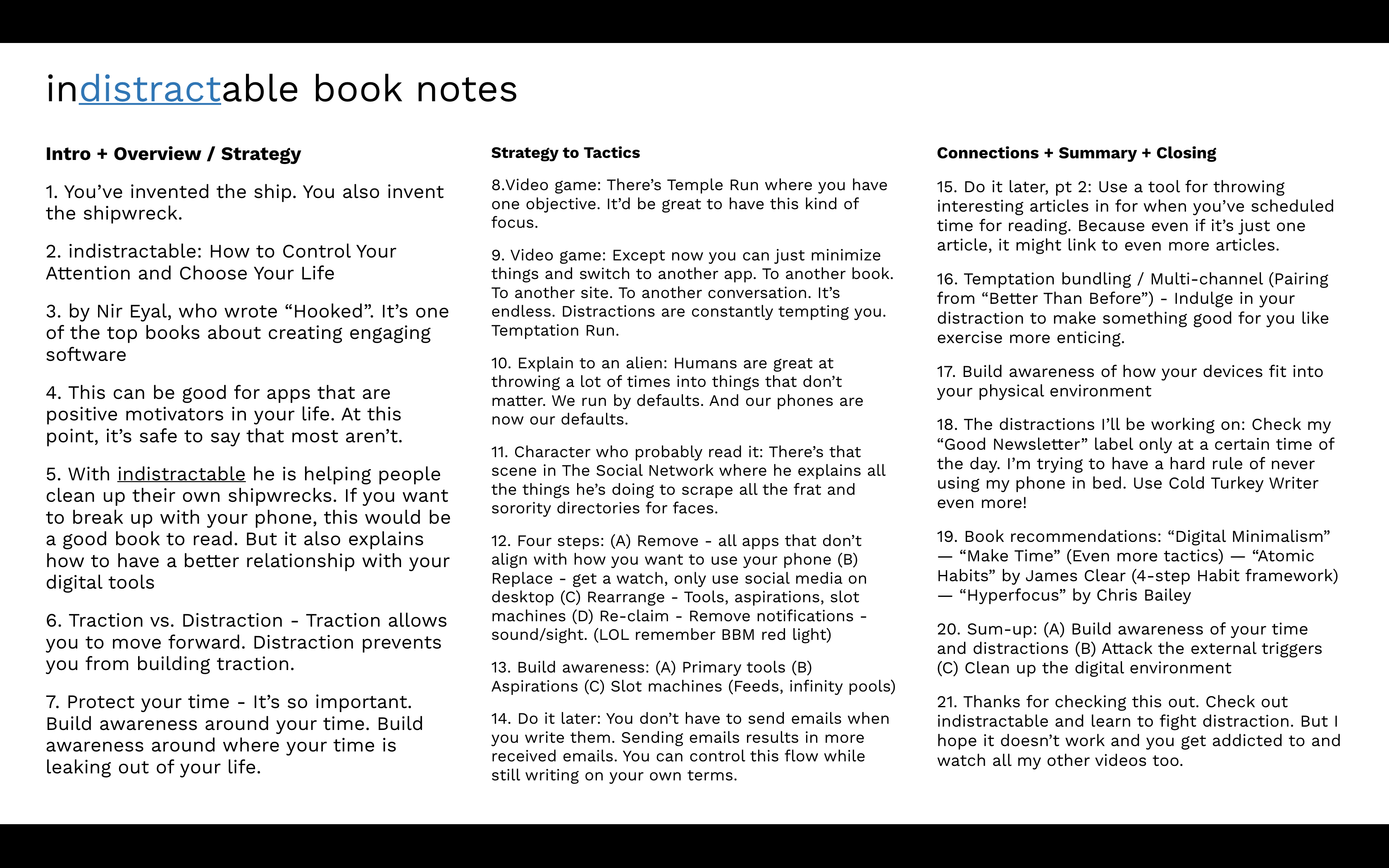
Check out the full notes for “Indistractable: How to Control Your Attention and Choose Your Life” by Nir Eyal

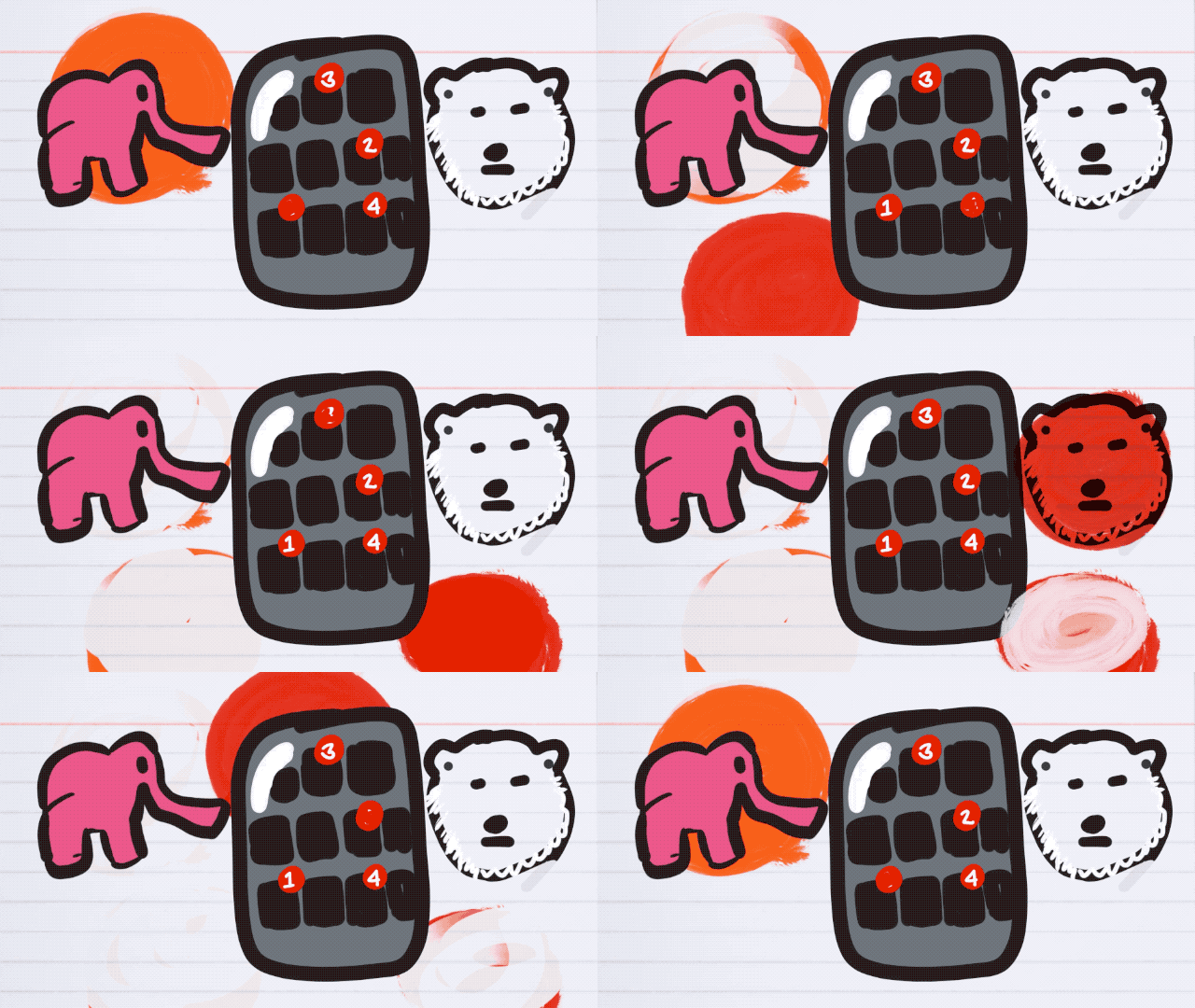
Don’t think about a pink elephant right now.

This never works. Similarly, if you want to avoid a distraction, using brute force might not work. Trying to not think about the distraction might just make the urge stronger.

Here’s what you can do instead.

The Indistractable Framework

Nir Eyal wrote Hooked, which explained how to build habit-forming products. The techniques described in Hooked are affecting your life in some way right now. Ever tapped a notification, refreshed a feed, or tried earning a badge?

You’re happy that you’re using some apps consistently. (The Five-Minute Journal app comes to mind for me.) The other like 95%, not so much.

Eyal recently released Indistractable: How to Control Your Attention and Choose Your Life.  It’s a great book about fighting against all the distractions in your life.

The framework in it has 4 parts:

  • Traction
  • Distraction
  • Internal triggers ?
  • External triggers

You’ll want to make time for traction, remove distraction, recognize internal triggers, and hack away at external triggers.

I’ve starred internal triggers because I think that focus is what separates this book from other self-development books.

Why internal triggers?

It’s easy to see how having an infinite stream of photos and videos of friends a tap away can be distracting. It’s not as easy to recognize that you’re distracting yourself from some negative feeling.

It doesn’t have to be existential pain deep inside you. Often it’s just a slight discomfort that leads to distraction.

You can often trace distraction back to four psychological factors. From Indistractable:

“Boredom, negativity bias, and rumination can each prompt us to dis- traction. But a fourth factor may be the cruelest of all. Hedonic adapta- tion, the tendency to quickly return to a baseline level of satisfaction, no matter what happens to us in life, is Mother Nature’s bait and switch.”

But it’s probably just boredom.

1. Start with why (but don’t go too far up!)

When you feel the urge to dive into distraction, ask why. Maybe just once or twice. Finding your capital-Why is great, but you can save it for another day. Today, you’re just trying not to grab your phone.

And it’s really because you’re avoiding something. From Indistractable:

“A common problem I have while writing is the urge to google something. It’s easy to justify this bad habit as “doing research,” but deep down I know it’s often just a diversion from difficult work.”

I wrote some things down that were whispering to me while writing the outline for this post.

  • Hey maybe I should order that bike pump (as if this can’t wait)
  • Oh yeah the bike shop is open maybe I should just go there instead (as if it’s going to close while I’m writing)
  • I should go grab a snack (this can wait also)
  • Need to use the restroom (not really)
  • Now’s a good time to check email (it’s almost never a good time)

While I made it to the end of my time block, during the break (supposed to be 5 minutes), I decided to take 20 minutes to dig through a bunch of junk to find batteries for an old camera. I didn’t want to use it today or anything.

At a certain point, I should’ve asked why I was looking for it, realized it could really wait, and got back to writing after my break.

2. Write it down (and make it concrete)

Writing down an urge allows you to capture it, give it some shape, and start asking it questions.

“Why are you pulling me away from my work?”
“Why am I talking to you.”
“Oh no you’re actually me.”

Reflecting on how you’re feeling in the moment might be new to you. Now’s the time to practice.

3. Spend time with sensations

If you write your urge down a few times, you’ll be better at recognizing the physical sensations tied to your thoughts. You can inject some logic and see how illogical it can be to give into a distraction right at that moment.

(For example, no I didn’t need to drop everything right at that moment to go to the bike shop.)

Even better, you cast a vote for yourself each time you capture and fight through an urge. If that same urge toward distraction comes up in the future, you’ll know that it will subside with some time.

4. Anticipate the urge and surf it

When you catch yourself doing something that will take “just a second”, consider how much time it’s actually going to take. Are you walking into a room and grabbing something, or are you walking into a room that has an infinite number of portals pulling you away?

One thing that’s stuck with me from reading Cal Newport’s Deep Work a few years ago is to try your best not to grab your phone when standing in line. Each time you do, you’re practicing being bored. (Read more about embracing boredom here.)

Standing in line is a liminal moment. There are plenty of others. From Indistractable:

Liminal moments are transitions from one thing to another throughout our days. Have you ever picked up your phone while waiting for a traffic light to change, then found yourself still looking at your phone while driv- ing? Or opened a tab in your web browser, got annoyed by how long it’s taking to load, and opened up another page while you waited? Or looked at a social media app while walking from one meeting to the next, only to keep scrolling when you got back to your desk?

If it has an endless feed, links to other articles, or previous items you might have left open, take 10 minutes before you open it up.

The harm comes in the consistency over time. It might truly be harmless to open it up in that moment. For that single time. But dozens of times a day, day after day adds up. You’ll condition yourself to never have a silent moment in your day.  Any amount of boredom is unbearable.

If you’re working and you stop to think through a problem, you’ll be prone to just distract yourself with something else instead. Small lull in a conversation with a friend? You’re playing with your toddler and you remember something from work…?

Surf the urge. It’ll go away soon enough.

Sum up

With some practice, you’ll be able to recognize and eliminate internal triggers (or at least minimize them just a little bit).

  • Indistractable Framework: traction, distraction, internal triggers, external triggers
  • Internal triggers are the step before the distraction

And the steps to reimagine your internal triggers

  1. Step back when you get distracted. Find out what the source is (boredom, shying away from work…)
  2. Write your distractions down to help recognize the feeling and to see patterns
  3. Spend time with the sensations to see how they progress and eventually go away
  4. Anticipate the urge and surf it. Learn where the liminal moments are through your day and make extra effort during these moments to apply the techniques

Now go off and be less distracted. And definitely don’t think about how great it’d be if you shared this post with a friend.

  • Book Notes
FocusIndistractableNir Eyal

Removing friction

September 5, 2019

Okay so I said “I’m bringing the podcast back.” in a standalone sentence to try to be bold. Then I didn’t actually follow through on finishing up the podcast.

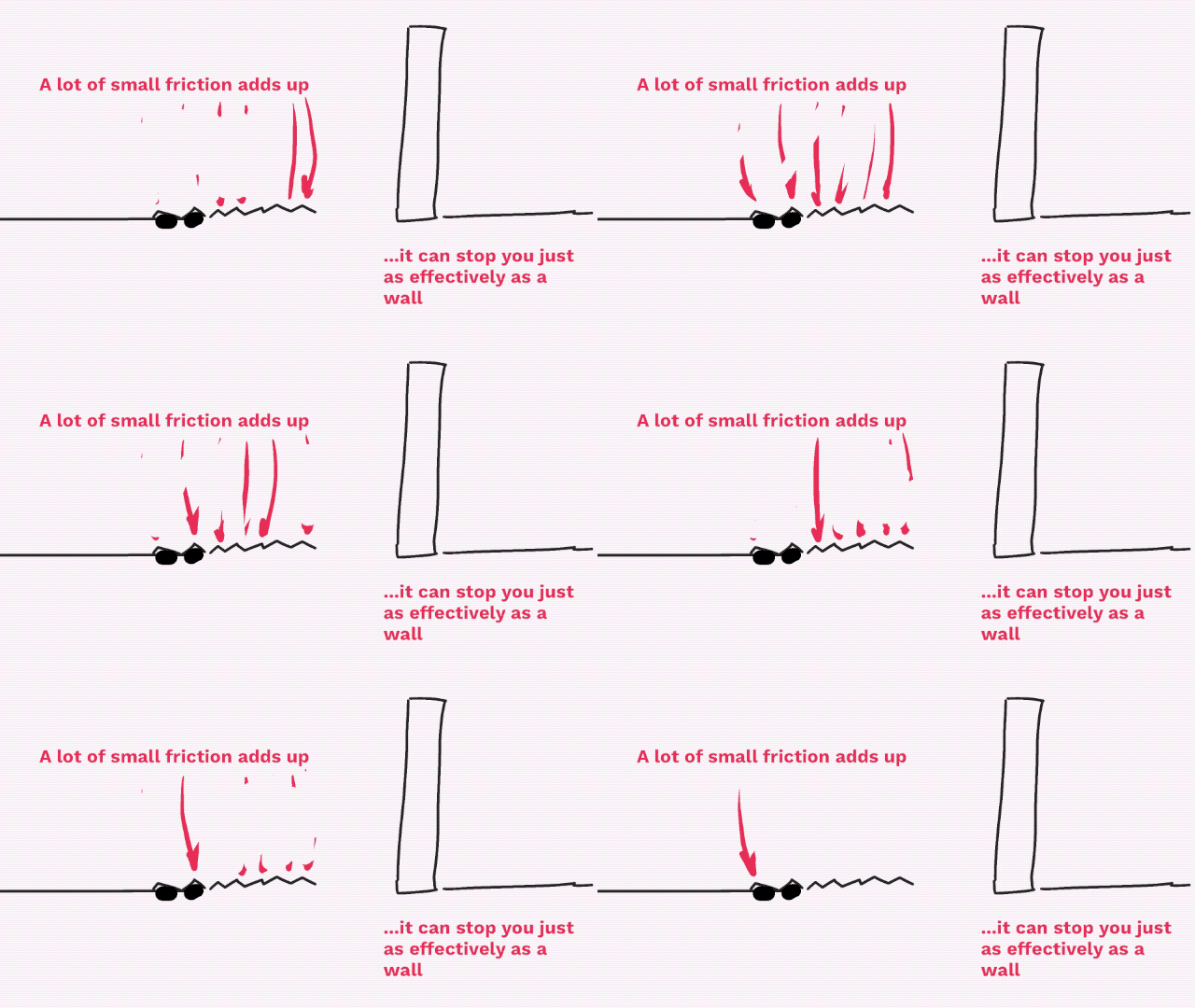
I’m going to think out loud (aka try to type some thoughts out here) to get down to why1 I haven’t actually recorded the podcast. Pretty much trying to find where the friction is.

  • The friction is all over. There isn’t really one single reason explaining why I haven’t made the podcast. I don’t want to record because I want to record at home on my mic with my laptop (when I’m probably fine recording on the Shure MV88 and my iPhone). I don’t want to edit because it takes a long time (this is a boohoo one because I actually know this time is really worth it but maybe I can time box this to get to some nice 80/20 spot). I don’t want to post because I’m worried that it’s going to be bad in the end (probably just need to read some stuff like ).
  • Starting something new is more fun than finishing things. I’ve started shooting a bunch of video for different ideas but then when it comes to editing I don’t actually want to go through with it. Because I’m pretty slow at video editing right now. And I’m probably actually writing this to procrastinate and not work on the podcast episode.
  • Matt D’Avella talked to Thomas Frank about how he works (video). He focuses on removing friction from everything in his work. Video is his main thing and there’s so much more room for friction when working with both video and audio equipment. Cutting that down goes a long way toward creating consistent content.
  • There’s mental friction from your schedule. The College Info Geek podcast changed their schedule from weekly to bi-weekly. I think I have some kind of mental friction here but probably not from the schedule. It’s me being worried that it won’t be worthwhile for other people to listen to. But I can take steps toward improving that by, well, actually doing it.

I’m making it hard (aiming for shows that require lots of editing), unsustainable (aiming for a daily schedule in my head), and inconsistent (because I let the friction rule over everything).

I need to remember what I’ve written about before: Make it easy, sustainable, and consistent.


  • Podcasting
Matt D'AvellaThomas Frank

Improving my solo episodes

August 20, 2019

I’m bringing the podcast back.

Which I’ve wanted to do before, but this time I’m going to document the process as I put the work in to improve it. This will be in the same spirit as the long journal post that I wrote about the first eight weeks of our podcast.

(Also, Wally and I are still planning to do episodes together. But for consistent weekly episodes, some portion will need to be solo episodes.)

Here’s some audio I recorded yesterday thinking I’d just jump back into the podcast. It’s an episode about Nir Eyal’s latest book, Indistractible

Well, it was going to be an episode about that. This is just the raw audio, recorded on my phone with the Shure MV88.

I put these notes together in Keynote:

Then I talked through them. The process I’m trying to get to looks something like this:

  1. Write plain-text notes: Or sort of plain text. I’ll probably start in something like Cold Turkey Writer and then move that into Keynote.
  2. Create podcast based on notes: I think this order makes sense because a podcast can generally be longer than a video. It also takes less time to make audio than video. Because a video also needs good audio. And you still need to make the video part.
  3. Create video based on notes: Well, based on the notes and the podcast. I’m going to start listening to the solo podcasts to figure out which points would translate best to video.

But it should start with text. Just going to put a couple links down here that came to mind:

  • Always bet on text – “We can read texts from five thousand years ago, almost the moment they started being produced. It’s (literally) “rock solid” — you can readily inscribe it in granite that will likely outlast the human species.”
  • The future of education is plain text – “Plain text is easy to mix and match If your lecture materials are in a simple plain text format like markdown you can copy and paste the materials from one lecture into another and when the document is compiled make all the formatting/colors/etc. match.”

But I didn’t post the episode above to the actual podcast feed. It’s only embedded here. I want to take the time to revise and give the same topic another go.

What I’ll do the next time through

  • Convert the 21 notes format into 5 takeaways: The idea was that I’d have 21 notes and 20 seconds for each note for a nice round 7 minute episode. I think that could work for a video with auto-forwarding slides that reveal the format and make the pace of it more forgiving.
  • Add some quotes: I want to make a self-development podcast and the best of those have expertise involved. Usually (A) the host is an expert or (B) the host interviews experts. There’s an episode of the “My First Million” podcast where Sam Parr says that there’s still room to create value if you’re a novice. Reading a book someone else hasn’t read can be far enough ahead to share something someone else might find valuable. So I’ll try (C) importing expertise with quotes from experts.
  • I’ll aim for 18 minutes: I think a 7-minute podcast is too short. I want to make things similar to the things I enjoy and I can’t think of any podcast I really enjoy that are less than 10 minutes. On the other end, I think anything beyond 20 minutes is too long for a solo podcast. (Unless you’re Bill Burr or some other form of professional speaker.)

I pulled 18 minutes from TED’s limit

Rest assured, you can accomplish a lot in 18 minutes. John F. Kennedy persuaded a nation to reach for the moon in 18 minutes at Rice University in 1962. Steve Jobs gave one of the most popular commencement speeches of all time in 15 minutes at Stanford. And in a TED talk that’s been viewed more than six million times, historian David Christian explained the history of the world in 18 minutes.

I’m likely never going to give a TED talk but if I’m going to pull a number out of the air, the 18-minute limit seems like a good one to steal.

Anyway, that’s the first post in this process of trying to improve the solo podcast.

Next up, I want to write a post that’s an overview of some of my favorite solo podcasts and some lessons from them viewed through the “I want to start a solo podcast” lens.

As a preview, here’s a note I wrote a few months ago with a list of some of my favorite solo shows. (Some are usually interviews but they do solo shows in between.)

solo-podcasts

Oh yeah and I’ll also do another take of the Indistractible episode!

  • Weblog

Podcast Notes – “My First Million”: Don’t make lists

August 18, 2019

Podcast: My First Million by Shaan Puri & Ishan Haque

Episode: Bonus episode! Answering listener questions (Apple Podcasts, Overcast, Google Podcasts)

I’ve been binging on “My First Million” the past few days. It’s fairly new (first episode is June 2019) so it was nice to not be overwhelmed by a library of like 400 episodes.

In this Q&A episode, Shaan Puri talks about lists and how making lists can be a big waste of time:

And people love making lists rather than actually just reaching out and trying to make the thing happen. I have a rule when we do this whenever we’re trying to do a project. I will tell the guys: what we want is to, in the next hour, we want to reach out to a customer or we want to reach out to a vendor. or we want to reach out… We want to actually fire the bullet we don’t want to spend a full day just loading the chamber of the gun. So making lists, I’ve found, is the biggest waste of time.

Making the list typically involves a lot of research and a lot of writing down things and it’s this false sense of productivity because you look at this giant spreadsheet and you say, “Oh man now we’re really prepared. Now we’ve got this huge list. That was a lot of work.” But the reality is it was just easy work because you didn’t have to get out there and actually, you know, interact with the market in any way. You were just doing research on your computer. So the biggest time waster I’ve seen is making lists.

This part reminded me that I’ve mostly just been making lists of ideas without actually finishing anything. I want to get some momentum with making and actually finishing things again.

The specific list is my list of podcast highlights. Here’s a glimpse of this list:

NewImage

There are a few more columns to capture the URL, date, and timestamp. The idea was that it’d make it easier for me to write posts like this one you’re reading right now. A single podcast link with a quote.

And here are a few more rows that aren’t so Joe Rogan heavy:

podcast-highlights 

This list is approaching 400 items. I’ve written maybe a dozen posts using this list to help.

Time to stop loading the chamber. I actually do have a huge list and am prepared. Time to actually start hitting publish.

  • Podcast Notes
Ishan HaqueMy First MillionShaan Puri

Video: Book note – Adam Savage’s “Every Tool’s a Hammer”

August 18, 2019

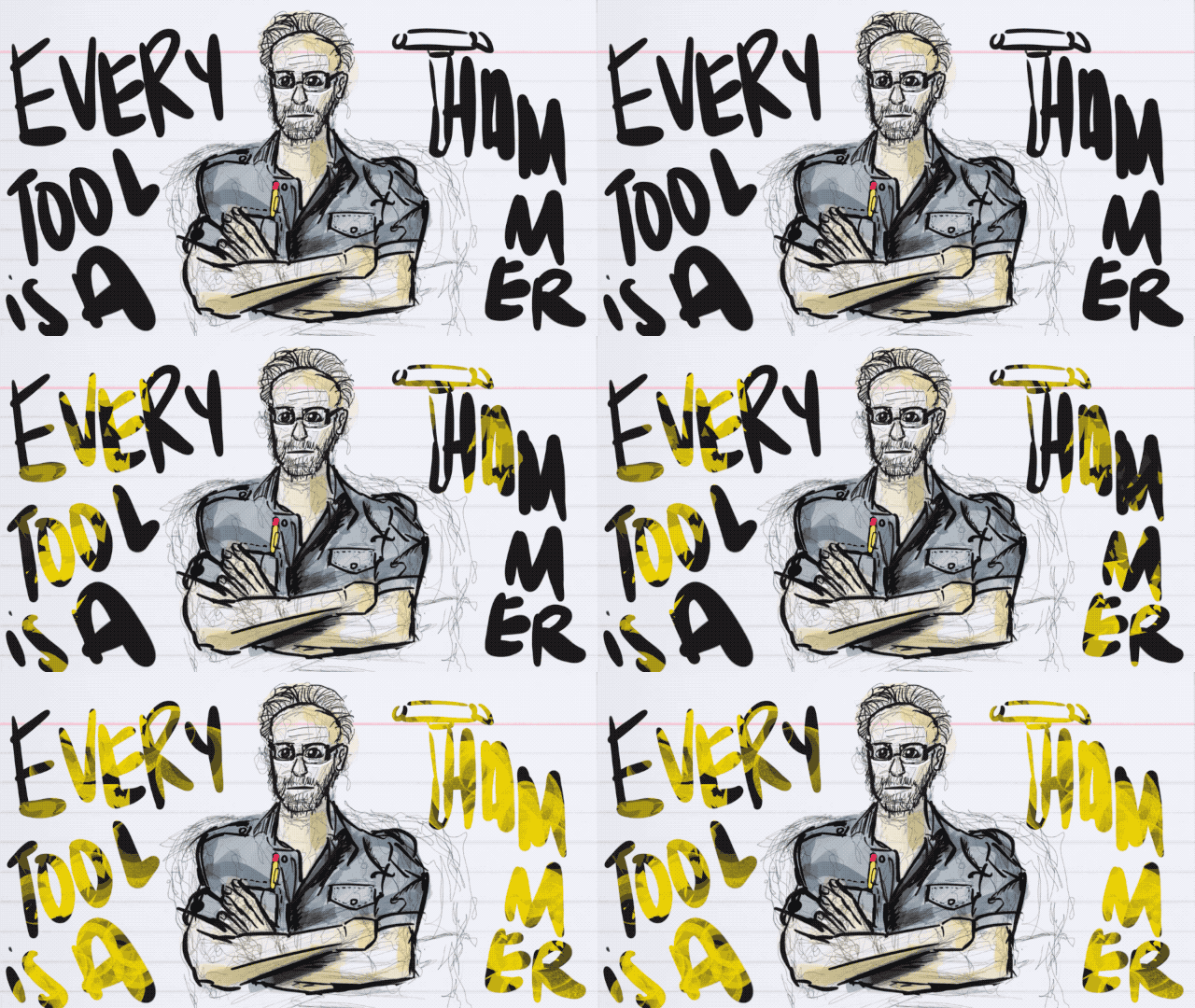
Here’s a video I made last month. It’s about Adam Savage’s book Every Tool’s a Hammer.

  • Videos
Adam SavageEvery Tool's a HammerVideo

Back to basics (and writing in the editor)

August 2, 2019

It’s been a while since I published anything on this blog. So I’m just going to write for a few minutes and post it to shake some of the cobwebs off.

I want to get back to the fundamentals. After all, the fundamentals are fundamental. I read Adam Savage’s book, Every Tool’s a Hammer, this past month. (Check out my video about it!) In one chapter, he talks about the importance of drawing in his process. It’s one of the fundamental skills in creative work. It was useful 1000 years ago and will likely be useful 100 years from now. It’s one of the most effective ways to transfer an idea from your head to somebody else’s. (Though it might be lower resolution than inception.)

I do want to draw more. But it’s the publishing muscle that I need to get reps in with. For me, publishing a blog post has the least friction of everything I make.

Maybe friction isn’t the word. A couple things come to mind that could better describe things. 

First, I went to a Chuck Klosterman book signing (go pick up Raised in Captivity, I’m loving it so far) — he talks about how writing has changed for him. It used to be that he could work on a piece, send it out into the world, and that was the end of it. There’d be a few reviews after, but there wasn’t really an outlet to respond. Now the release is the middle of the process. You then have to monitor people’s reactions and you have the means to react to each individual reaction if you feel like it. One of the luxuries of posting to a blog that nobody reads is that there’s nothing to monitor after hitting “publish”.

Second, time craters. This is a phrase from Make Time by Jake Knapp and John Zeratsky (go pick that up too!) — I read it last year and recently picked the audiobook up to go back through again. It’s great. I used to always appreciate when authors narrate their book. Then I got to some books where the author probably shouldn’t have narrated their book. Make Time is very heavily a good case of the author narrating their own book. Or co-authors, in this case. The back-and-forth translates really well to the audiobook.

Oh yeah, time craters. An example of a time crater is a tweet. You post to Twitter. It takes a minute. Then it makes the dinosaurs go extinct. Or your attention, at least. That tweet can occupy some part of your mind for the next few hours. How is it doing? Did people laugh? With me or at me? Did they react at all?

So I’m going to try to write more in the short term. Just get comfortable hitting publish with no reactions. And hopefully move on to where I’m a little more scared to hit publish.

  • Weblog
Every Tool's a HammerMake TimeRaised in Captivity
  • « Go to Previous Page
  • Page 1
  • Interim pages omitted …
  • Page 67
  • Page 68
  • Page 69
  • Page 70
  • Page 71
  • Interim pages omitted …
  • Page 106
  • Go to Next Page »

Primary Sidebar

Subscribe to the channel

Focusing on making videos in 2023.

✍️ Recent Posts

Keep the page turned

An idea for what I might try to make next: How do people transform?

Carve out time away from (crappy) flow

Switching it up: CrossFit and the welders of Rogue Fitness

Musashi: the age we live in (or something)

🎧 Recent Episodes

Takeaways: “Someday is Today” by Matthew Dicks | #126

125: Creativity x Fitness – Consistency, Classics, and Crane Kicks (3 links)

118: The Psychology of Fitness: 1, 2, 3

Popular Posts

  • Book Notes – “Awareness: The Perils and Opportunities of Reality” by Anthony de Mello
  • Lightning Round Questions
  • Kobe Bryant: Every day math
  • Journal: The first 8 weeks of Active Recall
  • How to succeed as a writer (What I’ve learned by reading Bill Simmons)

By Francis Cortez

  • About
  • YouTube Channel
  • Instagram (@activerecall)
  • Twitter (@activerecall)

Categories

  • iPad Pro
  • Podcast
  • Book Notes
  • Podcast Notes
  • Weblog
  • Videos
  • Fitness
  • Creative Pages
  • iPad
Back to homepage • By Francis Cortez (@activerecall)