• Skip to main content
  • Skip to primary sidebar

Active Recall!

Podcasts, videos, and iPad art

  • About
  • All Posts
  • Podcast
  • Videos
  • Book Notes

Podcasting Log: Zero to 18m audio (in 90 minutes)

August 29, 2020

Tried making an episode in 90 minutes. That seems like a realistic chunk of time to create a 20 minute episode from start to finish including outlining, recording, and any post-production (of which there isn’t much).

Got inspired to just get stared recording again because of Pat Flynn’s episode “EP 438: How to Start a Podcast and Why You Should!”. Just want to get into the swing of things again. So I made an episode about Ford vs. Ferrari.

I also don’t want to stop overthinking this blog. I’m going to start writing some a bit of a journal as I try to put some effort into improving both Active Recall (which right now amounts to getting back on a consistent schedule with Wally) and The Notepod (which will take more deliberate creative effort, since it’s harder to make a solo show interesting if you aren’t starting from being a professional entertainer in the first place aka if you’re not a standup comedian).

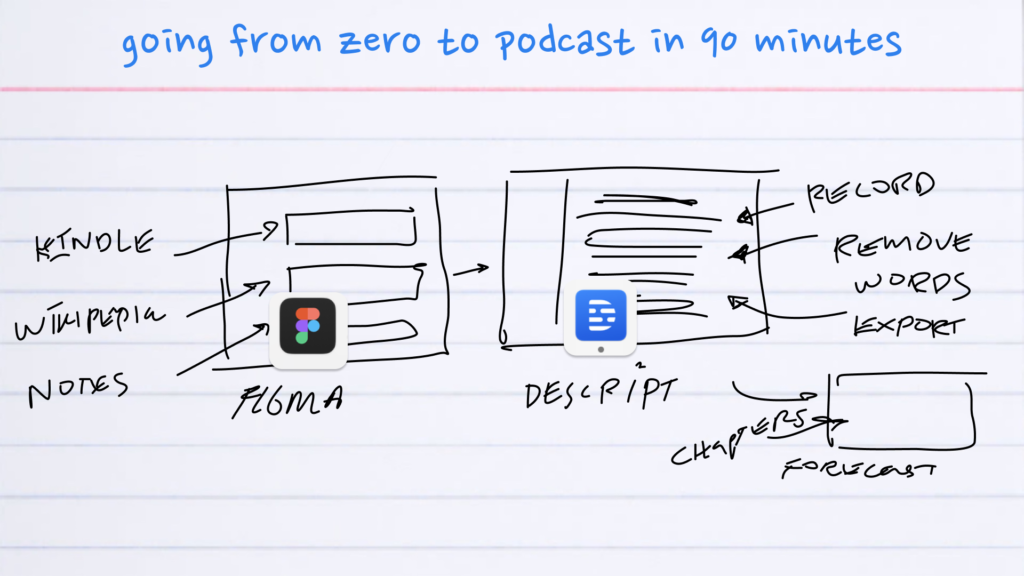
Here’s how I did the episode outline:

Figma

Oh yah so here were the steps depicted in the notecard I drew.

  • Outline in Figma — A somewhat unconventional option for putting an audio show outline together. I like it, well first because it’s a tool I’m very comfortable with. It could be a hammer/“everything looks like a nail” sort of thing, but it really does help me mimic having some printed out notes in front of me while recording. There’s very, very little friction when compiling notes from Readwise emails in my inbox, Evernote, and Kindle highlights by just screenshotting everything and pasting it onto the Figma page.
  • Descript — Again, I’ve gotten pretty comfortable using Descript from correcting a bunch of podcast clips to write my newsletter (which you should check out!) There’s so little friction for me to get to recording, remove “umms” and “uhhs”, close any large silences, and then get the audio file out. It also takes out so so much tedium from adding chapters. Though I still use Forecast to add the chapters, having text search in Descript makes it 10x easier to find sensible places for timestamps.

I’ll keep trying this and I’ll see if it works on an episode with Wally as well. In the meantime, check out the episode: “Notepod – Ford vs. Ferrari”. Actually, I just remembered I can embed it right here:

  • Podcasting Log
DescriptFigmaFord Vs. FerrariPat FlynnPodcasting Log

The Notepod #7 – Ford vs. Ferrari

August 29, 2020

[02:09] “We Don’t Need Roads” note

[06:51] “Apprenticeship Patterns” note

[10:46] “Every Tool’s a Hammer” note

  • Podcast

72: “Quarantine”

August 18, 2020

Books we talked about (some Active Recall CLASSICZ)

  • “The Obstacle is the Way” by Ryan Holiday
  • “Stillness is the Key” by Ryan Holiday
  • “Grit” by Angela Duckworth
  • Podcast

The Notepod #6 – Hackers and Painters

August 9, 2020

This week I’m talking about “Hackers and Painters” by Paul Graham.

  • “Do Things that Don’t Scale” – Paul Graham’s essay.

    “When you only have a small number of users, you can sometimes get away with doing by hand things that you plan to automate later.“

  • “Revenge of the Nerds” – Paul Graham essay.
  • That Tim Ferriss & Derek Sivers thing about The Magic of Thinking Big:
    “And, it’s also one of those books, sorry, but I’m getting defensive. But, it’s one of those books that I read in around 2000, maybe a year or two after college, and I was in a shitty 100-plus hour a week job, where I was sleeping at my desk, and sitting the the fire exit, because that’s the only place they can fit me. But, yeah, it has to catch you at the right time.”


  • Podcast

Podcast Note | The Ready State Podcast: “S1EP7: John Berardi”

July 27, 2020

  • Podcast
    The Ready State Podcast
  • Episode Title
    S1EP7: John Berardi
  • Episode links
    Apple Podcasts • The Ready State

John Berardi talks about self experimentation:

If you’re not trained in science, you don’t know how to do it properly. So people like find out what a great cliche is in the nutrition world. Find out what works for you, right? Well, who the hell has the tools to do that? A tiny percent of people, right?

It’s like saying here’s the secret to getting in great shape: dunk a basketball.

There’s only certain people can do that. You have to have, you have to be a certain height, you have to have a certain ability to produce force.

To me, finding what works for you is a skillset they need to develop—not just a thing everyone has access to.

So what I like instead of self-experimentation is guided experimentation. Get some guidance. Yes, it’s good to find what works for you.

Have someone help you through it.

I own John Berardi’s Change Maker: Turn Your Passion for Health and Fitness into a Powerful Purpose and a Wildly Successful Career but haven’t read it yet. This podcast definitely bumped it way up in the to-be-read list.

I flipped through it in Amazon Books (back when malls were open) and the thing that got me in the book was a really straightforward description of the Jobs-to-be-Done framework. I’ve read a bunch of explanations of it in startup books and things like that, but the section in Change Maker made it stick.

Oh yeah, some thoughts on the excerpt above.

Self-experimentation is good so that you can learn what works for you. But I like Berardi’s reminder that it doesn’t have to be all or nothing. It doesn’t have to be (all-by-your)self-experimentation.

Have an expert help you figure out what works for you.

Or just someone who isn’t as biased as you are. Everyone gives some advice that they don’t follow themselves.

Speaking of, I’ve gone way too long trying to self experiment when I could bring in some expert help. In the past few years, I’ve started to look toward experts a bit more but there’s still way more room for it. I’ll start looking for opportunities to get some coaching with kettlebells (gotta fix my swing) and other hobbies. I enrolled in a writing course last month and it’s been pretty transformative. Now I should do the same with design and anything else where I want to grow.

Anyway!

  • Podcast Notes
John BerardiThe Ready State

Podcast Note | Shea Serrano: Grit and central points

July 21, 2020

Podcast: Finding Mastery
Episode: Shea Serrano on Why It All Comes Down to Grit

I was excited to see Shea’s name pop up on my podcast feed. I’ve got Movies (And Other Things) on the bookshelf. I’ve listened to the Rewatchables Bloodsport episode more than a few times. And I’m definitely looking forward to The Connect, his upcoming podcast with Jason Concepcion.

One of my favorite exchanges on any podcast is Chuck Klosterman asking Bill Simmons about what you’d want to hear from a young writer:

Klosterman: “Let me frame it like this: You’re at a book signing. A kid comes up to you. You can tell the kid is smart. Just from his demeanor and the way he talks, the way he looks, the other books he has with him. Which compliment makes you feel better? ‘You’re my favorite writer’ or if he says, ‘I’m a writer. I want to be like you.’

Simmons: “I just know that when the roles were reversed, the writers that meant something to me were also the writers that made me want to write.”

I’m many years past being a kid at a book signing. But Shea is one of those writers that makes me want to write. (And one of those podcasters that makes me want to podcast.)

Here are a few takeaways:

  • Some writers are born to do it (most aren’t) — This is a talent vs. hard work perspective that I can get behind. Some people are born to do certain things. But it’s not many people. You can still separate yourself from the rest of the pack with hard work. Shea says he can just outwork people. He’ll sit and write for however long it takes to write the piece.
  • Shooters shoot — Shea tells a story from when he was a teacher and watching a kid get rejected on Valentine’s Day. It’s a different kind of expectations/reality. The expectation for rejection would be that it ruins the kid’s day, week, month. Instead, he shrugged it off and moved on. Be happy with the effort and don’t focus so much on the outcome.
  • Find a central question — He writes with structure going into each piece. On the episode, he breaks down a chapter from Basketball (and Other Things) about Michael Jordan. First, assume everyone agrees Michael Jordan is the best player ever. Then figure out which year Michael Jordan was the best Michael Jordan.

But it starts out very clearly: This is the point I’m trying to make, so every sentence that I write should help me arrive at that point. If it doesn’t help me arrive to that point then I delete it and keep it moving.

I’m just, like, carving carving carving until I get where I’m trying to go. It’s the same thing with anything that I write.

Keep carving. Keep shooting.

  • Podcast Notes
Finding MasteryMichael GervaisShea SerranoWriting
  • « Go to Previous Page
  • Page 1
  • Interim pages omitted …
  • Page 51
  • Page 52
  • Page 53
  • Page 54
  • Page 55
  • Interim pages omitted …
  • Page 106
  • Go to Next Page »

Primary Sidebar

Subscribe to the channel

Focusing on making videos in 2023.

✍️ Recent Posts

Keep the page turned

An idea for what I might try to make next: How do people transform?

Carve out time away from (crappy) flow

Switching it up: CrossFit and the welders of Rogue Fitness

Musashi: the age we live in (or something)

🎧 Recent Episodes

Takeaways: “Someday is Today” by Matthew Dicks | #126

125: Creativity x Fitness – Consistency, Classics, and Crane Kicks (3 links)

118: The Psychology of Fitness: 1, 2, 3

Popular Posts

  • Book Notes – “Awareness: The Perils and Opportunities of Reality” by Anthony de Mello
  • Lightning Round Questions
  • Kobe Bryant: Every day math
  • Journal: The first 8 weeks of Active Recall
  • How to succeed as a writer (What I’ve learned by reading Bill Simmons)

By Francis Cortez

  • About
  • YouTube Channel
  • Instagram (@activerecall)
  • Twitter (@activerecall)

Categories

  • iPad Pro
  • Podcast
  • Book Notes
  • Podcast Notes
  • Weblog
  • Videos
  • Fitness
  • Creative Pages
  • iPad
Back to homepage • By Francis Cortez (@activerecall)